
Chris Perkins
-
Posts
5,693 -
Joined
-
Last visited
-
Days Won
43
Content Type
Profiles
Forums
Events
Downloads
Store
Gallery
Articles
Everything posted by Chris Perkins
-
Standard BU coin in pack is £10 and I think the silver proof coloured version is £55 (and isn't available currently). The RM will make as many as they have demand for.
-
People are certainly speculating, but more on the ability to sell for more on ebay when the coin sells out.
-
Don't think I saw it! It's just my opinion of course. If the RM say it was deliberately sans denomination then no one can ever prove otherwise.
-
I know Rob, it was a bit tongue in cheek. They have no control over 2nd hand coin prices, especially ones from circulation, but I do sometimes feel that the odd error/anomaly that seems to occur certainly doesn't do them any harm. I think it's possible that a lot of new customers may have ended up buying RM products after the whole fiasco with the mule 2008 20p and the later problem coins that came to light after see them selling for enormous prices (enormous asking prices usually, selling prices are of course quite different!). All these things get reported in the media and talked about a lot and I know lots of people that seem to think buying new coin products new is a good investment. There were companies (that like to pretend to be a 'mint' or in some way associated with a mint) selling mule circulation 20p's in special boxes with certificates that they printed themselves... some even offered the mule 20p as a gold plated ltd edition and I think a lot of people can't really tell the difference between the RM and other sellers of hyped up new coins (from a business practice point of view there are actually very few differences!) Many even speculate on new coin products hoping for a low mintage when the mintage figures are released a couple of years later, or hoping for an error or something out of the ordinary. People have become so obsessed with potential RM errors that some even make a big fuss about spelling mistakes on the accompanying packaging/literature. Many don't really understand the nature of the errors/anomalies. The whole thing with the IRB no denomination Battle of Britain 50p for example.... it's common because they made thousands of sets and they'll always be available, but it's been talked about a lot because of the missing denomination and I bet even the suggestion that it was some kind of oversight caused more people to buy them than perhaps would have done so normally.
-
I don't see how a coin can be made with no denomination and be called 'deliberate', especially as they had a suitable obv that they could have used (the one which had 'FIFTY PENCE' under the Queen in smaller letters). It was a cock up and they're pulling the wool over out eyes. Is a coin with no marked denomination actually legally even a coin? Or it actually was deliberate and was done to try and make the coins more interesting, create more hype and sell more of them. But I doubt that on this occasion. They cocked up.
-
It was the same work experience boy that allowed them to produce a 50p without a denomination, then a different one for silver/gold proof before finally doing one that they could actually circulate.
-
In the last edition of the Decimal book I managed to completely omit a silver proof only crown. I think everything's covered in the version which will be ready in a couple of weeks. I don't think the RM (that I view simply as a quite ruthless money making machine that are actually turning people away from coins in the long run) know what they're doing either, they seem to willy nilly launch random coins, many of which are not actual circulating coins. So I can understand the Spink confusion. I have the 2015 decimal Spink book and the numbers seems to be all over the place, but a lot of that is probably due to the old throw back of listing by coin type, i.e. the different portraits, rather than simply chronologically for each denomination, both real denominations and the recently made up ones! I wouldn't class the silver proof £2 coins as mules with just the wrong edge lettering, but it's certainly something similar as it was clearly a human error to set them up with the wrong edge. Talking of mules, another one exists and so far only 2 are known - 2009 10p with the (wrong) crowned lion reverse instead of the Dent shield section. That's one that would easily be overlooked in change.
-
Is 4632 a 2015 50p? I don't think that number exists in my Spink, so it's probably from the 2016 edition? There certainly are both IRB and JC portraits for the 2015 50p. The RM aren't making things easy these days with the number of different coins they seem to be churning out.
-
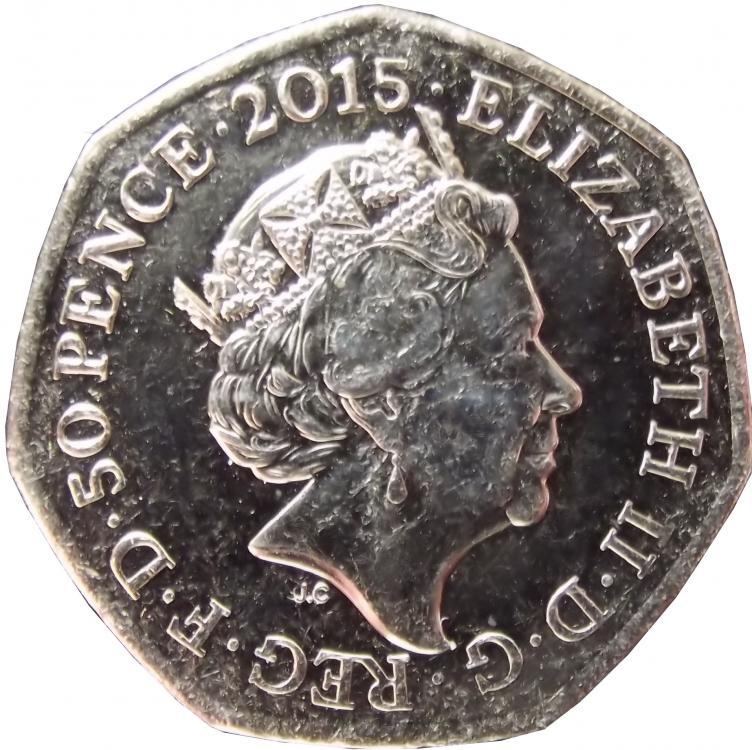
Oh, and something else bonkers about the Battle of Britain 50p: there are 3 types. In my book they are 49a - Ian Rank-Broadley portrait, no denomination, coins in BU sets only. 49b - Odd transitional silver and gold proof version only with the Jody Clark Portrait but still missing a denomination, and 49c - the circulation coin with the Jody Clark portrait and finally a denomination too. Also noted about the circ coin is that even from mint bags most of them are absolutely knackered already in terms of bag marks, scrapes, scratches, dents etc, like the one shown below. For £2 coins, I've also seen silver proof versions with the wrong edge wording. I had a 2005 St Pauls WWII anniversary silver proof with the edge 'REMEMBER REMEMBER THE FIFTH OF NOVEMBER'. And a slave trade silver proof with 'THE 4TH OLYMPIAD LONDON' edge has also been seen. Oh and for the slave trade coin there is a variety too - the coins in sets and the proofs had a tiny 'DG' (for David Gentleman) on the reverse. The circulation version has no DG and a different textured surface (and it now pretty rare in high grades). The most interesting £2 (IMO) is the standard 1999 coin as it wasn't included in sets and is now hens teeth in high grade. All in my decimal book
-
Very good. I had a glance. To add to the 1992 20p: there are clear differences between the large head and small head types. This is what I have in my 'Collectors' Coins - Decimal Issues of the UK... "The 1992 small head coin was thought to be scarcer than the large head, but new information would seem to imply that the large head coins are the coins that were circulated in large numbers and are now hardest to find (especially in top condition as most have seen normal usage). It is now thought that the proof version only exists with the small head. The easiest way to tell the difference is that the small head bust has a much sharper point where the neck ends at the bottom. The obverse 2 picture on the previous page is the smaller ‘sharp neck’ type." And that obverse 2, smaller head pic looks like this..

-

CataWiki New Sponsor
Chris Perkins replied to Chris Perkins's topic in Forum technical help and support
Hmmm, looks like something is blocking it (and others) from displaying properly. -
CataWiki New Sponsor
Chris Perkins replied to Chris Perkins's topic in Forum technical help and support
I'll have a word with them about that and see if they have a banner that auto re-sizes for smaller screens. -
I have a new forum 'partner' so you'll now see catawiki adverts on the forum pages. Catawiki are a Dutch online auction company that have recently set up a UK site. It's better than eBay in the respect that the listings are moderated by experts in each category field. They don't yet have the quality of items that eBay do, but what they do have should be of better quality, at least when they are established with a good number of UK based users. The auctions end weekly (currently 25,000) and they have many other categories from classic cars to jewellery and all manner of collectables. Please consider joining as a buyer or seller. A link is directly under this post (not sure if it's properly visible on phones/tablets yet, perhaps you could let me know).
-
No signature function ?
Chris Perkins replied to secret santa's topic in Forum technical help and support
Well done Matt, and thanks very much for sorting things so far. -
No signature function ?
Chris Perkins replied to secret santa's topic in Forum technical help and support
I have re-enabled signatures (they seemed to be off in the upgrade) and note that some people seem to have their old ones back again. I'm afraid others (inc me) may have to add them again manually. -
New Forum 23/12/2015
Chris Perkins replied to Chris Perkins's topic in Forum technical help and support
Signatures were apparently being re-built, but they don't seem to be back so I'm afraid we may have to manually put them in again (really sorry about that). I'm going to make Nordle11 an administrator now, as he seems to be fixing the problems (or offering work arounds) before I get a change to even find the cause! -
New Forum 23/12/2015
Chris Perkins replied to Chris Perkins's topic in Forum technical help and support
Sorry, not been around much lately. Happy New Year everyone. I will look closely at the new forum issues and see what I can do! -
Eek. What's happened?
Chris Perkins replied to TomGoodheart's topic in Forum technical help and support
What phone are you using Richard? Android? -
The forum was upgraded last night. It seems to be up and working, but there are likely to be little things that will need perfecting. I'll also need to add some minimal advertising. Please report here if you notice any issues. So far the quotes don't seem to be showing up properly and signatures aren't right - these are both being re-built in the background.
-
Yeah, it didn't fix it. I'm using up too much memory (RAM memory I have learnt, not actual storage space memory). It should be ok now though as I've had an upgrade with more power all round. It may even speed things up a bit. And a new forum upgrade is also now definitely on it's way, now that the server and all the important software is bang up to date. It was the fiddling required for the forum upgrade that caused the issue.
-
You're on the right track Paulus, but I don't think it's due to the penny posts. I'm running out of memory, both in real life and on the server. The server has been re-started just in case there was anything running that shouldn't have been. If not, then I'll have to upgrade to a meatier server.
-
the 1953 pennies
Chris Perkins replied to Mr T's topic in British Coin Related Discussions & Enquiries
I've deleted the attachment with the address. You may want to censor that part and re-attach. -
"view new Content" not working when you sign in
Chris Perkins replied to davidrj's topic in Forum technical help and support
No idea, but you know what, I think a forum sortware update is due. Let's see what new tricks and repaired old tricks that brings! -
Nice coins for sale , are they real !
Chris Perkins replied to SWANNY's topic in British Coin Related Discussions & Enquiries
Bit rude, crashing a topic to advertise a website that does appear to have some nice coins on offer, but also seems to use a bit too much marketing speak (akin to those well known peddlers of modern amazing limited edition rubbish) for my liking. Today I changed the security questions and have banned a couple of IP address ranges in an attempt to stop the current increased (mostly Polish) spam account registrations. -
Happy Birthday ChKy
Chris Perkins replied to azda's topic in Nothing whatsoever to do with coins area!
Alles gute zum Geburtstag Dr K.