
Rob
-
Posts
12,984 -
Joined
-
Last visited
-
Days Won
389
Content Type
Profiles
Forums
Events
Downloads
Store
Gallery
Articles
Everything posted by Rob
-
There are a few varieties, but nothing of any notable value because few people collect them.
-
Leaving aside the contentious locations for certain Civil War mint issues, there are a few glaring mistakes in the list - particularly assigning the Briot marks to Bristol. A lot of the provincial marks are particular to an individual engraver or location, so things can get a little messy to say the least, whilst one or two are still uncertain.
-
OK, I obviously didn't explain it very well as I was using the halfcrown as an example, where the profile is clearly a 4 sided podium with 5 distinct flat areas at completely different angles and I would have said struck from multiple blows because I don't think the force on the bounce would have been sufficient to strike up the different sections. The area showing the flash is sharply angled to the middle section and the bottom angle is equally sharp. Only the section from 9-11 o'clock isn't well struck. I can see the smaller ones will only require one blow and your explanation make perfect sense. I did say the die was struck from correctly made dies.
-
Cameo or not ? Be wary !
Rob replied to secret santa's topic in British Coin Related Discussions & Enquiries
I don't know is the answer, but given the majority (all?) of disputed pieces are those where there is a relatively large mintage, it is quite conceivable that the really good ones are just early strikes. Clearly frosting is not a pre-requisite for a proof, as quite a few of the rare proof year coins for Elizabeth II are not frosted. Apologies for the crappy scan, but the attached 3d is clearly not frosted, yet the mintage was minimal.
-
It depends on whether it is classed as an imitative type or not as to where it is likely to be listed. I've checked there's nothing with the above description listed in Chautard for Florent V, but you could try looking in Engel et Serrure if you can find someone with a copy. Sorry, don't have one - a big gap in the library. Maybe John (Argentumandcoins) has a copy?
-
No, the detail will have been entered using the individual punch components in the correct place, with a small allowance for position from die to die. What has happened is that it takes a few blows of the hammer to make a coin from the finished dies, particularly in the case of those on a larger flan. If either the dies or the blank move relative to each other between blows, you can get what is termed a double strike. It is quite common for this to occur, in fact a cleanly struck large module hammered coin is a very desirable thing. The attached shows the effects of multiple hammer blows. 5 blows were required to strike the coin - the obvious angled parts top and bottom, together with the centre band which is similarly (but less obviously due to lighting conditions), angled on both left and right. The bit in the middle is flat. It also shows that the blank moved a little between strikes as indicated by the discontinuity in the inner circle by the horse's rump.

-
Or to put it another way - double striking.
-
Cameo or not ? Be wary !
Rob replied to secret santa's topic in British Coin Related Discussions & Enquiries
Do they care? It is the TPGs and collectors who assign the 'Cameo' designation. I wouldn't be surprised if all the RM worries about is the polished field, the sharp milling and the square edging to characters and the rims that is required for a proof. -
Cameo or not ? Be wary !
Rob replied to secret santa's topic in British Coin Related Discussions & Enquiries
The reflected view will depend on the planarity of the die's field. Many dies are slightly domed to give a dished surface and so you will only see the image at the focal point. Getting a picture of yourself is therefore a bit hit and miss. -
Cameo or not ? Be wary !
Rob replied to secret santa's topic in British Coin Related Discussions & Enquiries
This is going to rumble on and on ad infinitum. FWIW, my take is a pre-requisite of good frosting, but absolutely mirror-like fields to complement it - as below. The field is the most crucial component in my opinion.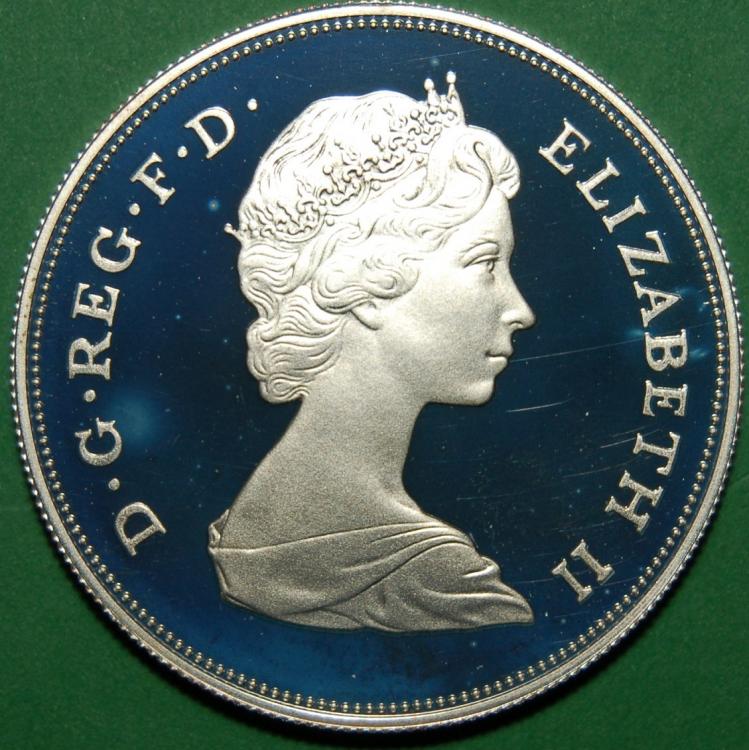
-
If he has been told by a dealer at Charing Cross that it is a £1200 coin all day long, then they would offer him £800 for it without question - somewhat better than the £430 net he will receive from eBay after costs. Wonder why he doesn't sell it to them?
-
Here you go. Here's one with the sprues still on it

-
Quiet. Everyone was finished by 2 o'clock.
-
Ah. Cadbury mint halfpenny - I only have a penny so wasn't on the ball.
-
Why is it a mule? Sorry I'm not too well up on unofficial things like tokens. Who made it for example?
-
Require Historians' Help re a Victorian Period
Rob replied to Coinery's topic in Nothing whatsoever to do with coins area!
Shows how much I can remember. I recognised the name, but the building eluded me. It's further down closer to Manchester at no. 266, was Grade II listed, but redeveloped, and now appears to be a Seat garage. https://salfordhistory.blogspot.co.uk/2017/02/knoll-house-salford.html The guy in question was there from 1874 to 1891 according to the article. -
Rare date in high grade, so lenience with the grading? Surely not.
-
Thanks. That will do for the database. I only knew who acquired it.
-
Require Historians' Help re a Victorian Period
Rob replied to Coinery's topic in Nothing whatsoever to do with coins area!
The Victoria St address would be next door to Manchester Cathedral too, so another reason for having a studio there. -
Require Historians' Help re a Victorian Period
Rob replied to Coinery's topic in Nothing whatsoever to do with coins area!
I have no idea where Rock Mount or Dover St were. Much of the area has been redeveloped since the sixties. Bury New Road is still the main drag up the hill out of Manchester, but houses are virtually non-existent these days, with almost everything lower down below no. 390 flattened 50 years ago and redeveloped for business use. 36 Bury New Road would be next to Strangeways Hotel close to Waterloo Road amongst the asian wholesalers' premises, all bar a few builings of which post-date this period. Knolls House is 397 Bury New Road. Even some of the redeveloped bits were redeveloped again in the 90s onwards - Hooray!! Victoria Street is the continuation of Bury New Road, down by the Manchester Arena and Chetham's School. Almost everything has gone here, but the school would have opened up business opportunties. His residential address would have been between the two business addresses. Based on a theatrical group sharing the same address at Knolls House, it is unlikely that he lived there. Certainly the property is too large for a single family to live there, so both 1879 addresses would be business ones. I think all we can conclude is pre-1886 when he is recorded in the city centre. -
Require Historians' Help re a Victorian Period
Rob replied to Coinery's topic in Nothing whatsoever to do with coins area!
I'm assuming the building was split up into businesses even then, because the card I illustrated reads ENT STA HALL after his name, which I would take to mean Entrance Stairs Hallway, i.e. by the front door. In the 50 years leading up to WW1, Higher Broughton was quite a well to do area, so a lot of people living close by would have had their pictures taken there. -
Require Historians' Help re a Victorian Period
Rob replied to Coinery's topic in Nothing whatsoever to do with coins area!
Searching the address gives a visiting card ca1880 for the Corps Dramatique. Knoll Street goes off Bury New Road. I'm pretty certain the large house at the top of the road looking down it to the left used to be called Knoll or Knolls House. Now it is split into a textile importer and Orthodox Jewish School. https://www.google.co.uk/search?q=pellstrand+ltd&ie=utf-8&oe=utf-8&client=firefox-b&gfe_rd=cr&dcr=0&ei=1msEWon4HanS8AfPwaboAQ Follow the link and it will give a view and a map. -
I don't think it is a case of repairs, rather one of using the punches available. Throughout the centuries engrvers have been adept at making up complex designs from a series of small punches. If you have an I with a missing serif, it is easy to invert the punch to make a full character. It is certainly easier than making a new punch. Time and money, I think. Other examples include making a composite G from a C with the upright added, or entering two Is with a crossbar added to make an H. An A was usually made from a V punch with the crossbar added, which is why they are frequently weak and so you need a top grade example to confirm that the crossbar was never present in order to claim an inverted V for A variety.
-
It is with deep regret that I have to announce the loss of a forum member. I was informed yesterday afternoon that Geoffrey Cope, aka Petitioncrown on the forum has passed away after a lengthy battle with cancer. Geoff was a passionate collector of Roman coins and those of the British Isles, who had sought only the best pieces for over 50 years. His enthusiasm for acquiring new pieces was undiminished right up to a couple of weeks before his death. For a few years now, his stated mission was that if he could inspire 10 people a year to collect coins, then he had done his bit to make the hobby safe for the future. It is fair to say that a quick perusal of his website should inspire anyone interested in history and art to collect coins. As a great supporter and patron of all things numismatic, frequently making items from his collection available to museums in order that they should be available to a wider audience, his death is a loss to the wider hobby. My thoughts are with his two sons and their families at this time.