

Rob
-
Posts
12,976 -
Joined
-
Last visited
-
Days Won
387
Content Type
Profiles
Forums
Events
Downloads
Store
Gallery
Articles
Everything posted by Rob
-
I was in that position, but service is now restored. Couldn't get on to say I couldn't get on. Chickens and eggs spring to mind.
-
I thought we had all that. Must have got a job lot in.
-
This is a common but misguided complaint which I have itemised previously. I will do so again. For the seller to cover themselves against claimed loss is a minimum £1.85. You cannot reasonably protect the contents within a 5mm thick packet for most items, so large letter is required. It would only be 20p less in any case as signed for letter rate. Cost of a Jiffy bag is 15-20p. Cost of printing out the invoice is 5p. You are already at £2.05 minimum. If you are VAT registered you are required to charge it on shipping, so the cost is now £2.46. Is 4p over cost really that excessive? To cover your eBay and Paypal fees would actually require a charge of about £3.20 or so. alternatively you can cover your fees and take the risk on shipping, but either way these are expenses that need to be covered if you are selling. Nobody sells to help the buyer - they do so to make money and there are two sides to a balance sheet or set of accounts. As I have long maintained, people on eBay are unrealistic in their expectations, and frankly the place is best avoided.
-
Which is why eBay is such a drag. 99% of this material needs to be melted which would be good for the environment and good for numismatics. With everything priced at 99p it sets the bar for people's expectations on price. The world has a long way to go before there is a shortage of low grade material. I know I send tens of kgs to the pot every year and that is just a drop in the ocean. In fact, it makes you wonder at which point it is worth not melting. A while back I acquired a virtually full run of bronze pennies (missing 1869, 1870, 1926ME and 1950), mostly in fairly dire condition with the best Vicky no better than fine. Given the undesirable state of most, I bulked them up with a load of across the board 20th century to get rid of a few kilos, it had no bids despite only asking for scrap + fees + shipping + 10% as a starting price. My scrap man was happy to do a BIN with no time wasting eBayer to worry about. I would have no hesitation in limiting things to one relist before scrapping, or just cutting out eBay altogether as future policy. Sure I'll check for the odd obvious rarity, but that aside it really isn't worth the time and effort. A washer for 99p including postage is a waste of time for everyone. With the cheapest shipping method possible, after fees it leaves 11p to be divided between the scrap metal value, packing and cost of getting it to the post office. The cost to the environment is considerably greater than 11p.
-
1889 Penny / Die Pairings and Date Widths
Rob replied to alfnail's topic in British Coin Related Discussions & Enquiries
Good. You're all doing very well. It helps if your starting point is where only a single die is known. Two dies is not impossible, but the job is a lot harder. -
1889 Penny / Die Pairings and Date Widths
Rob replied to alfnail's topic in British Coin Related Discussions & Enquiries
Good. You now have a starting point for extending the die pairs forwards and backwards. Next job is to find the reverse die(s) previously paired with the earlier obverse, and then any reverse(s) paired with the later obverse. Then you are on a roll and can take it as far as the evidence allows. You also have to bear in mind there was more than one press in use at any one time, so the potential for crossover is also present. -
Twas always the same. This time in 1979 we intended to go down Birk's Fell Cave above Buckden, but couldn't find the entrance for snow. Oh well, it's only at the bottom of a 10-15' shakehole which had temporarily ceased to exist. Three weeks later it was 20 degrees plus.
-
1889 Penny / Die Pairings and Date Widths
Rob replied to alfnail's topic in British Coin Related Discussions & Enquiries
No, missing the point. On the assumption there is only one N over reverse die, you are looking for wear/developing flaws on this die and then looking at the obverses to see which die is paired with it in either the early or late stage. The state of the two obverse dies is irrelevant as they are different, so an increasingly decrepit obverse die is merely telling you whether two examples are early or later with that die pair, but not which came first. A single die will have been changed when it became unserviceable, but they would not necesarily be changed as a pair as this is un-necessary expense. It is this point which allows you to sequence die pairing. -
1889 Penny / Die Pairings and Date Widths
Rob replied to alfnail's topic in British Coin Related Discussions & Enquiries
It is the wear to the reverse die you are interested in. Developing flaws etc that allow you to sequence the obverses. -
B****r. Missed out again. I didn't get one.
-
1889 Penny / Die Pairings and Date Widths
Rob replied to alfnail's topic in British Coin Related Discussions & Enquiries
Good, so now you know which two dies were paired with the N over reverse and you can work out in which order they were used. All essential information for working out a die pair matrix. Then you pair each obverse with another die and start to build up the sequence. -
Or just be more patient
-
Happy birthday from the same frigid northern wastes.
-
Matteo gets up earlier than me. I concur. Swetman could be written SPEDMAN or more likely with a Ð (TH) given the use of the wen (P)
-
I agree regarding the lack of scientific application. Personally, I feel the 1645s are likely to be over-represented due to the almost automatic illustration of any flat crown 1645 despite there only being a couple dozen or so. I did start to make a list of identifiable Newark siege pieces, but lost the will to live a few years ago. Whatever the distribution, there is no excessively large skew suggesting that coining took place continuously for months prior to the New Year, nor that coining only took place in (literally) a few days leading up to New Year. The actual periods when coins could have been struck are flexible to a point, as money of necessity only it would be made as a last resort after any available coin had been used. I think we can be confident that dated coins were struck in the appropriate year. If there had to be a case made for an issue considerably earlier, that would have to be the flat crown pieces, but their relative rarity suggests a very short striking period. The two spellings of NEWARK(E) on the regular shillings might be indicative that shillings and ninepences with the terminal E were concurrent with the flat crown shillings. If so, one might be inclined to consider these were struck at a completely different time to those without the E. That would favour an early striking such as the arrival of Charles with a significant number of troops, thus requiring plate due to the immediate supplies of coin being insufficient. But the quid pro quo for any early output is a reduction in the length of time for late strikings, i.e.that would negate any lengthy striking period in Feb/March 1645 because I think we can reasonably assume similar survival rates for both 1645 and 1646, plus the spelling varieties. The absence of many halfcrowns dated 1645 poses a bit of a conundrum. As the basic pay for a cavalryman, you would have expected a fairly even distribution across the dates. Was there a large supply of halfcrowns, yet no shillings? What also seems unlikely is that there would be a large output of shillings and ninepences relative to halfcrowns when the majority of Royalist troops by this time were mounted cavalry. Charles' infantry was decimated at Naseby, so you would have expected the halfcrown/shilling ratio to increasingly favour the former, if it did in fact change. If the spelling of Newark has any bearing, then it might be that coins without the E represent the striking period leading up to the surrender, in which case, the ratio of 1645 to 1646 Newark coins as a whole gives us the approximate split for the period leading up to and after the New Year. The levies would have fallen on the inhabitants once the town was under siege with any Royalists taking refuge likely to be assessed in name only unless they were fortuitously ably to carry their wealth with them. I don't know if records exist for Newark covering the siege period, but those surviving at Chester record fortnightly assessments of £200 during the autumn months. However, there is no confirmation that these sums were actually collected in full. There is a record of a shortfall on one occasion. Again, at York, Slingsby records that there was no money or plate surviving towards the end. So much we don't know that I wish we did.
-
It still doesn't tell us when they started producing coins unfortunately. 1646 is unquestionably commoner than 1645, but production has to be limited to a six week period with this date, so I wonder how late in the year they started using plate. If striking was pro-rata to time, then production couldn't have started before February, unless levies were collected in plate only at some point. One would assume that levies would have been collected mainly in coin until it ran out and plate only converted out of necessity, but confirmation of that would rely on council records from the time.
-
The Copthorne collection of pennies
Rob replied to PWA 1967's topic in British Coin Related Discussions & Enquiries
You'd have thought so, wouldn't you. It was never going to stay a secret on a forum that's 50% penny collectors - be serious. I wondered which route he would take. -
Only up to a point as we aren't quite talking from the same angle here, are we? Carlisle was undeniably under siege and not in a position to expect relief, so the issue was only ever likely to be used internally. Newark was not out on so much of a limb, had a history of being under siege, even though it had not struck coin on previous occasions and from the Parlimentarian point of view was a continuing thorn in the side. It is fair to say that it would not have surrendered in May 1646 had it not been instructed to by Charles. Therefore, the use of fine silver of the correct weight is not surprising given its use elsewhere for Royalist issues. Charles was quite anxious that standards should be maintained, and presumably would have given instructions to that effect when he passed though in the summer of 1645 following the defeat at Naseby. (Is anybody aware of a date for when striking commenced?) Pontefract was in a far more precarious position given it was the Second Civil War, where the rebels were limited in numbers and their position defined clearly as traitors following the insurrection. This was never the position taken by either side regarding other English soldiers (Irish were different) Although Ormonde was instructed to negotiate a truce, this was effectively from a position of equality with the other side. Although various towns and cities came under attack and were essentially under siege, both sides had the upper hand on occasion, so his position was not comparable to the above three places. Use of touched silver meant that standards were maintained, even across the Irish Sea, thus guaranteeing the men would be paid in good money, and their purchased loyalty ensured.
-
It might just be a disintegrating punch.
-
-
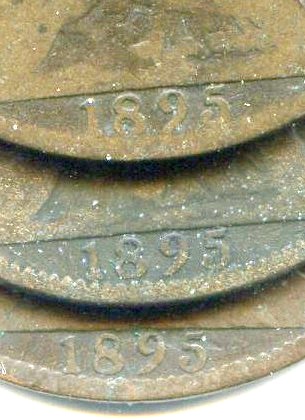
The only thing I would have considered vaguely significant was the two 5s, one upright, one slanting slightly right. I would have expected the font not to change.
-
Strikes me that there must be most of these variations in date width for most years around a certain date. Just a cursory look through the crap pile gave two shapes of 5 for 1895 and two date widths for 1896 (1 narrower) and 1899 (1 wider). That was just a random sample of 14 veiled heads. Not statistically significant, but does make me question their absolute rarities. Edited to add and 1897
-
Yes, their value was changed to reflect the adoption of New Pence. A touch of realism perhaps in recognising that nobody would ever spend them as face value coins, yet equally recognising the history and their place as a tangible gift that could be spent, having a face value.
-
Not guilty m'lud. Despite 60% of this year's purchases having been pennies, not one was made of bronze.
-
Unfortunately the surviving mint records of the time don't list the privy marks involved at any particular time. However, we know that London used pheon, castle, and crowned (sometimes) portcullis on the silver, and gold additionally used a castle with H superimposed in the period 1509-26. If we assume that the first mark for the reign was pheon because that was the mark in use at the end of Henry VII, that would have accounted for the initial output. We can reasonably assume that castle followed pheon, and that was followed by portcullis. Portcullis, crowned or not, is much more common than castle as a mark which probably only lasted a year or two, so we can probably say that crowned portcullis covered most of the period in question. As there are only three marks for silver, it is clear that the pyx was either infrequently tried, or multiple pyxes were made for the same mark. We know that there are groats with crowned portcullis over crowned T, which was the mark used at Tournai during the period of English occupation from 1513-8. However, I don't have any details for how long the mint operated there. Politics would suggest that the mint started operating as soon as was practical in order to show the locals the English money as the new landlords, and indeed there is a groat (4 known from 2 types dated 1513). The town was captured on 23rd September 1513, so this would suggest coining took place soon afterwards. Tournai was returned to the French in October 1518 upon payment of 400000 crowns (Snelling) at which point any dies would have returned to London, if they hadn't already done so. Therefore we can say that crowned portcullis was in use either during the period 1513-8, or immediately afterwards because of the dies with the recut mark. I would lean towards the (crowned) portcullis mark being introduced in about 1512 or 1513 based on the rarity of castle. This would leave 12 or 13 years for the mark to run, but it is possible that pheon was in use concurrently as the mark is not that rare. It could equally have been used, stopped, and then reused, or even used throughout the 17 year period. There is documentary evidence that a trial was made before Cardinal Wolsey and others of two kinds of money struck between 1st June 1522 and 15th October 1523. Eighteen satchels contained £7/16/- in groats and halfgroats, taken from 14886 pounds weight Tower. This at least gives the amount of silver coined for these two denominations in the period, if not the total weight of silver, because pennies et infra were not included and their distribution not noted. Whether this corresponded to a change in privy mark is uncertain. We do know that the same mark was used in two different periods for the second and third coinages, and these only separated by a few years, so it may have been standard procedure to alternate(?) between pheon and crowned portcullis, or even have uncrowned portcullis as a third mark, but this is only conjecture. It's possible that crowned portcullis, which is a common enough mark for the angel, was mostly struck using the proceeds of the money received from France in 1518, but don't quote me on that one. Best guess is therefore sometime between 1513 and 30th October 1526. This isn't particularly helpful in answering your question and doesn't add anything to what is already written, but is the best I can do.