
Rob
-
Posts
12,976 -
Joined
-
Last visited
-
Days Won
387
Content Type
Profiles
Forums
Events
Downloads
Store
Gallery
Articles
Everything posted by Rob
-
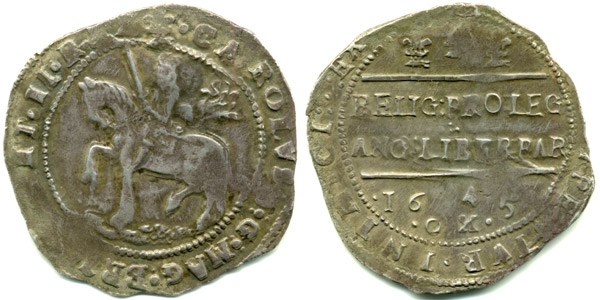
A whole new grading challenge! A lot of these must have slipped through as 'clipped' I'm thinking. I'm presuming this is a phenomenon consistent over a number of flans, and they've been on the button, weight wise? Could it be that the engravers were expecting larger flans, but the silver was just coming through too thick? There are 3 decent examples of the 1645 F7. Mine (ex-Lockett 2460), Carlyon-Britton (1921) lot 337 and Morrieson 534. All are well centred, but missing the reverse periphery. Attached is a less desirable example off Lloyd's site, which although off centre on the reverse, is still too big.
-
Morrieson's BNJ articles on the Bristol, Oxford, Shrewsbury, Aberystwyth, Coombe Martin & Lundy. Besly BNJ, York & Truro/Exeter. Allen BNJ, W/SA + Vincent supplementary data. Lockett BNJ, Truro & Exeter. Then combine all these articles with hundreds and hundreds of sales catalogues, sylloges, Bull, Charles I halfcowns etc. Thanks, Rob, I'll be taking a look! Sorry, I also forgot Lyall's Chester article in the 1971 Circular
-
On the question of diestock diameters being potentially larger than the denomination, this rather desirable Shrewsbury shilling from DNW 79 says it all. The obverse is nearly all on the flan. There is no way the reverse would ever fit on a shilling sized flan, being barely able to fit a halfcrown. But it is definitely a shilling rev. die because of the 3 line declaration. The second coin that sprang to mind was the Oxford 1645 F7 halfcrown. Again, the obverse is full, but the reverse is too big. Neither of these are double struck which would be a potential explanation for off flan detail. The only conclusion that can be drawn is that the bar end was a greater diameter than the denomination norm, and was engraved too large in error.
-
Morrieson's BNJ articles on the Bristol, Oxford, Shrewsbury, Aberystwyth, Coombe Martin & Lundy. Besly BNJ, York & Truro/Exeter. Allen BNJ, W/SA + Vincent supplementary data. Lockett BNJ, Truro & Exeter. Then combine all these articles with hundreds and hundreds of sales catalogues, sylloges, Bull, Charles I halfcowns etc.
-
This is my 2F halfcrown. You will see a flaw by the 3rd hoof. Spin the picture round and you can see that it is an arm holding a sword. There is also a stop between I & T of BRIT. If the dies were cut on a cylinder, it is unlikely that you would get more than a trace of double striking. You certainly aren't going to get the cylinder jumping out and rotating by 180 degrees. The dies have to be removable, which is why I say the cylinder theory is wrong. The 2F is one of the rarer die combinations.
-
This will kill a few birds with one stone. Below is my 'Hartlebury'. By the OL of CAROLVS you can see a lion. This only appears on York coinage. To the left of it on the inner circle is the remains of the sword and another example shows the flaw between Charles' foot and the 3rd leg to be a foot and spurs. Clearly this is a York die, and appears to be the 1A die pair, but I can't confirm yet. This creates a problem for Besly's article on the York coinage in the 1984 BNJ where he states that the equipment used at York involved the use of a cylinder press with the dies engraved on the cylinder. The evidence for the shillings is quite compelling with 5 discrete die pairs and 5 pairs which appear to be rotated by one die. The same cannot be said for halfcrowns as my 2F is clearly a re-engraved die (details to follow), coupled with the fact that some die pairs are common whilst others are out and out rare. I suspect the rare ones are recut dies, such as the 2F. There is also evidence that some of the W/SA dies are ex- York dies. Clearly you cannot take a bit of the cylinder, so the assumption must be that the equipment either had some sort of clamping arrangement to hold a number of dies, or they were used as individual pairs. This also throws a spanner in the works regarding the attribution of Hartlebury which is considered to be struck in 1646 as there is no way the dies would havve been removed from York by July 1644 and lain unused for nearly 2 years. Also, the siege at Hartlebury only lasted a day, and Worcester wasn't cut off at this point which isn't favourable for a siege coinage. A somewhat larger spanner is the fact that the 'Hartlebury' dies are recut to form the CHST below the horse Chester issue, whose obverse was recut to form the Chester declaration obverse which is dated 1644. 1646 it ain't. 'Hartlebury' it ain't either. The pear/3 pears marks are I believe, gerbs. The obverse has only one stalk, but the reverse 'pears' have 3 stalks. The pears are lion paw/claw punches as seen at York. I think the HC coins are probably Hawarden Castle, and were struck to pay the troops returning from Ireland in Dec. 1643 because there is documentary evidence that Byron arranged for all these troops to be paid 2/6d for each common soldier (they hadn't been paid for 2 years previously). Hawarden is 4 or 5 miles to the west of Chester on the road from the landing points at Mostyn etc. Anyway, enough spanners for the time being - to the 2F next
-
Coin Auction Houses..any views?
Rob replied to Colin88's topic in British Coin Related Discussions & Enquiries
I suspect we both had grief from the same place, albeit with me as a buyer when I bought a bulk lot of hammered described as VF-EF, but only one coin had a portrait! So much for the cataloguer's credentials. And another occasion where the error was meticulously described with a 2 line write up, but non-existent!! -
Coin Auction Houses..any views?
Rob replied to Colin88's topic in British Coin Related Discussions & Enquiries
Depends on the material. I have used St. James's, Baldwin, Spink, DNW and LC. Lower to mid grade/value items will not suit the first. Baldwins seem to have quite a few unsolds from their general sales, so maybe push the estimates a bit high. They can also drag identical things to those you want to sell out of their basement at the drop of a hat giving unwelcome competition. I've not really had any grief with any of the above, so would only suggest that the items are placed where the best prices are obtained for each category. -
I'll sort something out later when I've time.
-
By definition this must be mutually exclusive. If there are say for example 1% of coins extant that are uncirculated (this is over-optimistic)then any online coin auction could only hope to get the same small percentage of people to use it because most things out there are crap and will always be so, but everyone wants to maximise their return and if this means calling something unc just to get eyeballs, then this is what will be done. It's a free country and not criminal to overgrade in the literal sense, but a combination of ignorance and a moral compass pointing south will ensure that an honest description will never be popular with the masses. I just wish a few more people would open an account with a scrap metal merchant.
-
So that explains old catalogues with no price for uncirculated. Old Seaby lists and Spink Circulars used FDC for an as struck, well struck currency coin for many years. UNC is a relatively recent description
-
Hammered coin dies were just a piece of diestock with the design engraved on the end. When a new design was required, all they did was rub down the old one and re-engrave with the new. A die could therefore have many re-incarnations. Sometimes there was sufficient detail remaining from the previous die(s) to work out what it was before, so the Chester declaration reverse die was previously Oxford halfcrown 1643 rev. 23 for example. It also appears to have been one of the small date 1644 dies too, but I'm still working on that one. The obverse die with which the declaration reverse is paired was recut from the CHST below the horse die, but the re-engraving was rotated and displaced from the original, so we can be certain that the die was of a greater diameter than that of a halfcrown because they wouldn't have engraved only half the design with the remainder off the side of the die! Next coin up would be a crown, but equally could have been big enough to accommodate a triple unite or a pound/half-pound. It also explains why some dies are far too big for the denomination on which they are found. A Shrewsbury shilling reverse and Oxford halfcrown 1645 rev.7 immediately spring to mind.
-
Die cracks can also indicate other possible reasons concerned with the equipment used or the state of the dies. One thing I stumbled across is that the Chester halfcrown with the declaration reverse is only known with a large flaw on the left hand side of the declaration. I suspect that this was due to a mismatch in the size of the dies. The obverse die was definitely big enough to accommodate a crown design even though it was used for striking halfcrowns, whereas the reverse die may have been smaller as it was previously used for halfcrown reverse dies which were not engraved on diestock identifiably larger than halfcrown size. The shear forces associated with a rocker press which has a crown size die overshooting the edge of a smaller die with which it was paired would account for the edge of the reverse die partially breaking. With no collar to restrain the edges, the trailing edge of the smaller die would have the vertical force used for impressing the design translated into a sideways force as it left the contact position which could fracture along any lines of weakness.
-
Double post again.
-
A cracked die would just be incuse detail of the raised detail seen on the coin. Cracked dies are very useful for chronology, as you can then sort out the order in which different coins were struck if they use a common die. So for example, the 1824 halfcrowns had a number of different strikes which probably ended with those struck in Barton's Metal, as this coin has a large number of flaws not seen on any of the other varieties.
-
Pretty cool, though I'm not sure how comfortable that sofa would be! I just hope they went through all the coins first to pick out any rarities before they trashed them. I somehow think the world will not run dry of washers to utilise. The results are not unattractive. I must admit to only giving the scrap pile a cursory check, mainly for the odd better quality coin. I'm certainly not going to check every washer for rare dates or varieties before they get consigned to the pot, and past experiences on ebay suggest people are reluctant to even pay a quid for 100 meaning they can't be bothered to search either. Saving the planet from un-necessary mining activity is the next best thing. You do make me smile, Rob! I'm just so, so, glad you don't take this whole thing too seriously! I couldn't take you seriously otherwise! :-) As I approach my fourth birthday, I'm thinking of settling down a bit and becoming more responsible. But I will draw the line at checking washers.
-
Pretty cool, though I'm not sure how comfortable that sofa would be! I just hope they went through all the coins first to pick out any rarities before they trashed them. I somehow think the world will not run dry of washers to utilise. The results are not unattractive. I must admit to only giving the scrap pile a cursory check, mainly for the odd better quality coin. I'm certainly not going to check every washer for rare dates or varieties before they get consigned to the pot, and past experiences on ebay suggest people are reluctant to even pay a quid for 100 meaning they can't be bothered to search either. Saving the planet from un-necessary mining activity is the next best thing.
-
Did you make a note of any prices? I had bids on a few things, mostly farthings. There were some nice ones in the sale.
-
As you are obviously monitoring this seller, could we arrange a pinned thread somewhere to list the items regularly offered together with a few pictures, or links? This can only be beneficial.
-
It was, limited to 10m, and that's not the Isle of Man.
-
It would have helped if the RM hadn't changed the crown from a 5 shilling/25p denomination to £5. The listing says a £5 coin. Whether they realise or not, I don't know, but they are clearly expecting the buyer to think it's a £5 coin.
-
Don't know why it does this. repeat post.
-
Relax, chill out and assess coins for yourself using your standards. Nobody is forced to buy a coin just because it has a number on the label. Frequently the number assigned will be at odds with your assessment. For a better chance of satisfaction, go with your own feelings about the coin that you will have to live with until disposal. I have a 61 that is better than a 65 of the same type, both in the collection. The real bonus is the strict pricing applied in the US where a 61 is a non-coin and hence can be purchased cheaply. Number collectors will turn their noses up at excellent examples of coins simply on the grounds that another example has been graded higher. Make the most of the situation on the ground and fill your boots.
-
I agree with Peck, in these very low grades even rare coins aren't worth much. For a 1903 HC in a low grade, there is probably a range of £30-£150 from Good - Fine. Beware of edge knocks, dinks, scratches and graffiti too. If you are anything like me, you will get far more pleasure from owning an attractive coin, compared to a low grade rare date for the same price Yeeees, sort of agree. But collectors like to put together date runs and any run of 20th century halfcrowns is going to be limited by what grade of 1905 and to a lesser extent 1903 they can afford. When I was collecting I used to have mental limits below which I would not go; good honest wear was okay but blatant cleaning, damage or graffiti was definitely beyond the pale. It may not be a popular view but within those limits I would much rather have had a coin 'in the hole' rather than a glaring gap. It is always possible to upgrade and I used to find this one of the most satisfying aspects of collecting. Anyway, it would be nice to see a picture of spw's halfcrown. 'NVG' can cover a multitude of sins! .........starting with not very good.
-
White balance raises its ugly head whatever the background. I also use backgrounds that give the lowest failure rates which, for me, involves 2 background colours, dependent on whether the coin is silver, bright bronze, or lustred, etc. I started using that old text background because it was the most effective, colour wise, but it made it difficult to cut the coins out with software afterwards, which I decided to start doing for tonal consistency of backgrounds across the website, recent additions list, etc. So I now use matt black and white for photography. As an indicator, the white background can be anything from blue, green, right through to pink, by the time I've played with the image in a photo suite! I then cut it out in Serif Plus and, hey presto, the background is brilliant white for all my images. That sounds like too much time required if all you want to do is load up a few images of coins for sale. As nice as perfection is, time has a cost. It already takes a few hours to add half a dozen coin images to the site given the vagaries of auto-defocus, flash working or not depending on the levels of light available, camera shake. Needless to say, it acts as a drag on the enthusiasm for listing things. I have to confess that I thought it would be much easier and take less time to take decent pics and upload them than it does in reality. It would be better if these clever cameras (which do everything except make a cup of tea), could adjust the image to give a standard colour. i.e. they know what 6000K white or whatever looks like, and every picture taken should be corrected, or at least correctable to this or these pre-set standards. I can see that you would need more than one reference point to cover absent reference colours. They must have some digital value corresponding to a particular shade of a colour which can have a specific number of bits added to or subtracted from it, or is that an unreasonable presumption?