
Rob
-
Posts
12,976 -
Joined
-
Last visited
-
Days Won
387
Content Type
Profiles
Forums
Events
Downloads
Store
Gallery
Articles
Everything posted by Rob
-
 I think most of us are on a hiding to nothing when it comes to setting a goal that is remotely possible. I'm happy with my 12 or 1300 criteria covering Roman to the present day as I can't complete it but it always gives me something to go for, even if it is usually not what I had in mind when I started out that day! It means I can happily accommodate cheap and cheerful things alongside out and out rarities without compromising the collection because everything would have a legitimate place based on my eclectic criteria - even a current copper clad penny sat alongside a 5 guineas would have equal merit. The only issue is discipline, as 'too nice to sell' and 'too nice to pass up' frequently divert me.
 -
You'll struggle with some of the hammered even if you get close with the milled. This one isn't going anywhere and the other is in the BM. It's not the only type you will struggle to get.

-
That would be a perfect example of something to push the boat out on a type collection. Find me another. Type trumps variety every time though. William III silver is riddled with varieties, some of which are very rare, some to my knowledge unique, but unless they are listed in a reference volume are very difficult to shift.
-
It's difficult to see which direction the market will go, though you can speculate. It is now very difficult to imagine anyone getting anywhere close to completing a denomination. When I refocused from shillings and halfpennies in 2008, I had a list of 1500 and 2200 varieties respectively just from the various references plus a few others I had identified which were not listed. That was already unfeasible. The same would apply to any denomination with the exception of say double-florins, or quarter guineas. Even the latter with just two currency dates plus a pattern wouldn't be easy. There may be varieties - I don't know. Even for the well-heeled, 5 guineas would cause a headache. Murdoch had the most comprehensive collection of these to date with 43 types out of 47 known in the collection, though he didn't collect by variety (assuming they exist). The days when even a secondary collection would have a dozen or more are long gone. The list goes on. You are in the same boat with reign type collections. I would suggest that Edward VII is probably the only realistic chance of completion, because the rare pennies of the later reigns may not be available even if the money is. What does all this mean? I think you will see a greater number of type collections. Maybe there will be an increased interest in foreign coins which are frequently cheaper due to lack of demand. Date runs have always been popular, even for those without reference books (I often get asked for 1961 halfpennies or 1923-5 & 1941-3 pennies etc, so clearly they don't have even a basic guide).
-
Total for the sale - $2.6m. Plus nearly 700K for the 75 lots in the Sweetnam sale earlier that day. Spink must be happy.
-
Yes. If concentric then you would have the legend all over the place without restraint, even if it wasn't double struck. The complexity of locking two rings in position for each side and furthermore locating and locking them in the press so that the die axis is maintained is mind boggling. Don't forget you also need a collar, together with a mechanism for introducing the blank and expelling the struck coin. Not a penny, but the same principle applies. https://www.coinbooks.org/esylum_v18n51a24.html
-
british sixpence/mauritius quarter rupee obverse mule
Rob replied to Mr T's topic in Confirmed unlisted Varieties.
Don't forget the conversation I had with Graham Dyer a few years ago as outlined in this thread. http://www.predecimal.com/forum/topic/12611-an-interesting-conversation-regarding-oddball-mint-strikes/?tab=comments#comment-171284 -
I know NYINC was cancelled, but thought auction houses may have advertised and that buyers had set aside funds for the week notwithstanding the various lockdowns, just as they try to hype up Coinex week. Money sitting in peoples' pockets is usually restless, which is probably the reason for the recently inflated prices due to the lockdown, with everyone being forced on-line. The only apparent thing is that the world is awash with money.
-
Question for Vicky or Jaggy here. That was the Spink NY sale which happens at the same time as all the others, Goldberg/Markov, CNG Triton, Heritage etc. This is an established set of sales with a strong following, so was the US interest piqued for this one compared to the usual interest, as the sale also had a larger number of slabbed coins than usual for Spink? Presumably with the US market in mind, the Sweetnam sale a couple hours earlier was partially slabbed. Given his name was on the slab where applicable, I assume that they were slabbed with the US in mind, even though it wasn't originally a US sale being priced in pounds. Was there any hype in the US prior to the sale?
-
british sixpence/mauritius quarter rupee obverse mule
Rob replied to Mr T's topic in Confirmed unlisted Varieties.
It isn't in the 2000 edition as far as I can see. -
I think it has been double struck. There are a couple of anomalies to the centre such as the line on the shield to the right of the trident shaft which is rotated approximately correctly for the legend displacement, and the left trident prong is mangled. The lettering is better formed on the right R of the pair and you can see a colon underneath the terminal A. In fact, all the left letters appear marginally thinner than those on the right, which would be right if they were the first strike, subsequently reduced by metal inflow from the second strike. Same applies to the date where it is the right digit of the pair which is thinner.
-
Spink can only sell what they are asked to. As you point out, the frankly vile sixpences were depressing. I ploughed through them all to see if there was an overmark in the hammereds that would have ticked a box, but no. Nothing esoteric and little of quality. Even when one coin in a lot was half decent, it was usually mixed with others that you would have difficulty selling. It isn't a new problem. Most collections are run of the mill material, and have to be because low and middle grade coins make up the vast majority of coins extant - it's just that they don't usually go through Spink, so people who regularly buy through them are going to be disappointed when these appear. Even Walter Wilkinson's collection had a few dogs in there (a few of which I bought), but sometimes that's all there is known of the variety. The point I take from recent sales is that there must be a new cohort of buyers who have no experience of what some coins can look like based on the prices paid for indifferent material. Maybe a decade or more of dross on ebay has reset standards in what people perceive to be quality?
-
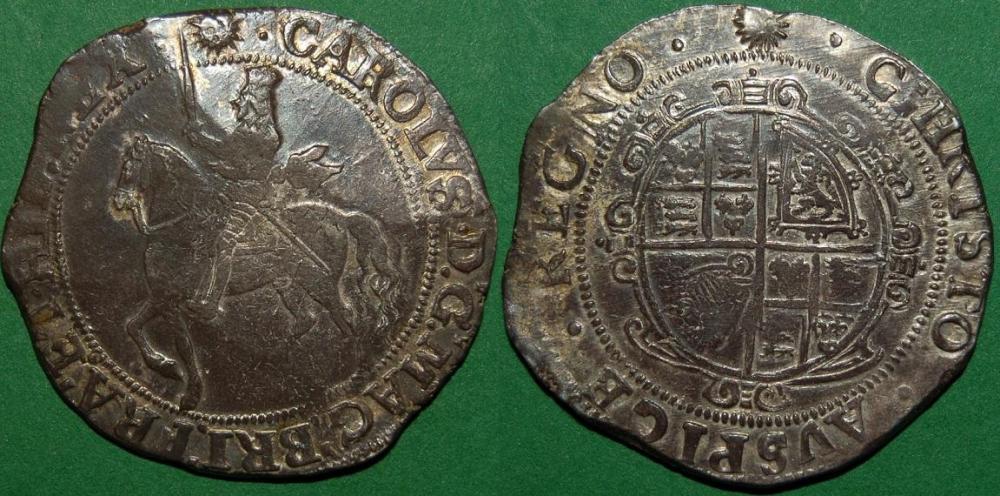
We had this discussion a while ago. Dave Greenhalgh was here saying you only had one blow with the hammer, which is unquestionably true for small coins (he does this all the time). The hammer can bounce leading to double striking, but I think the question of more than one blow could apply to larger modules. I used my type 5 halfcrown as an example, see below. There is unquestionable double striking by the horse's rump and by the S on the obverse, and the N & H on the reverse. The relief of the obverse has a significant change of angle which is obvious with the lighting, and a similar profile change in the diametrically opposed part of the flan. I couldn't see how a bounced strike could produce such a large change of angle whilst still producing what is quite a well struck up coin. Looking to pick holes in my thoughts, the only way you could get this profile with a double change of angle would be if the die was cut with the angles as seen, which isn't impossible. Although it is counter-intuitive to presume the die was engraved on a deliberately non-planar surface, I suppose an angled profile such as this would constrain movement along the 1 o'clock/7 o'clock axis, but the lower and less angled profile on the 10 o'clock/4 o'clock axis would allow some lateral movement. The double striking seen on this coin would agree with the above, so maybe I'm wrong in thinking it was struck more than once. Don't have a ouija board to find out.
-
Yep, it was absolutely bonkers. Safe to say my collection is the same today as it was yesterday morning.
-
It's rotated between strikes. The A is seen twice, but the other doubled letters have been erased. You can tell there is a displacement from the state of the inner circle.
-
I've been looking at this too and am wondering if it is a trace of a former die that hasn't been polished out. There are plenty of polishing marks which suggest it had a former life and some of the residual lines are wider than file marks being the same width as seen on the shield quartering, such as that by the harp.
-
Quite common across all flan sizes. The number of double struck coins implies that they did not reject them for this reason. The only important criteria was the weight, as each silver coin was supposed to have it's value equal to the silver content. It may or may not detract. A screwed up portrait such that you can't make out the features or an illegible legend will count against it.
-
Oh, I see now. Didn't read it fully as I usually struggle to plough through the drivel, and wouldn't buy whatever it was in any case. I think it has to be a design issue, because anything to do with spelling or grammar doesn't come within her capabilities. To quote the listing without amending in order to convert it into English. 'Have a read because. these will soon be extreamly expensive as I will be soon letting the cat out of the bag ..and informing sellers that's when they go up in price believe me I did try to tell you ..yes for a small fee but for the information. .one pound is a bargain I know error coins ...take for instance the brexit 50p A LOT don't know it's an error but fact is ..it is Prosperity don't have an Oxford comma on the end as it should ...but the coin I talk about will be worth much much more don't miss out it's a stonker of an error coin'
-
There was a number of mind boggling prices today. I guess the first sale at midday set the scene with hammer prices at twice the estimates across the collection. It's always depressing to think you might have a bid at 2 or 3 times the estimate, only to see it sail off into the distance. I thought lot 259 looked quite an attractive proposition in the 2-3K bracket against a 500-800 estimate, but 8 or 9K? The same could be said for any number of lots. It will be interesting to see the final totals. The last couple of years have played havoc with my purchasing.
-
Won't be that as it's up for a quid and free postage. The £2 with the four legged tripod would represent a loss. After fees it has to be a 10p or smaller, unless the blunder is to list something at a loss?
-
EBay charging 20% VAT up front
Rob replied to jelida's topic in British Coin Related Discussions & Enquiries
All this specifying the VAT rate by sellers is irrelevant for exports, as the only VAT applied is on importation. i.e. the vendor would be required to know and upload the rates for each item in each country they sell to. Items listed on ebay by business sellers are required to be VAT inclusive as far as I know, because it is deemed to be similar to a shop, the reason being the public see the full price inclusive of all taxes as they are unable to reclaim any of it. Businesses have to ask for a VAT receipt and claim it back if registered. The rate of VAT in the country where the item is listed is not important because ebay doesn't collect 20% on internal sales. Nor should it. -
EBay charging 20% VAT up front
Rob replied to jelida's topic in British Coin Related Discussions & Enquiries
I suspect it operates under the same system as for shipping to certain states in the US whereby sales tax is payable by the purchaser and is automatically added to their invoice, though as a seller, the money doesn't actually land in the vendor's account. As a seller, they won't charge the VAT personally, and let's face it, most sellers of coins are private individuals, many of whom don't believe VAT is due on any transaction, nor that HMRC should be in any way involved. Ebay are therefore acting as a tax collector at the point of import to get around this issue. What's happened here is likely to be a half baked operating method, whereby ebay only apply 20% VAT and call it quits because the number of 5% items is minimal in the context of imports. I suspect the only way around it is to get payments out of ebay's control working again in whatever way is possible. You will lose buyer's protection (if it means anything), but given most people on both sides are honest, it should work for much of the time if the will is there. Making a separate Paypal payment outside eBay and ensuring the seller puts the right description on the customs label will work, but for low cost things, say up to about 75 quid, a 20% payment to ebay will be cheaper than the Royal Mail or courier admin fee plus the import vat which will become due if not already paid. Alternative is to veto it, because they are unlikely to listen to reasoned argument having already agreed terms with HM Gov. Ebay applying the right tax would be the cleanest and most equitable way forward, but don't hold your breath. I'm also wondering how the Royal Mail will know that import tax has been paid? Their default position has to be charging tax unless there is proof of prior payment. I don't know if the code that seems to be included in the address of every purchase is connected to this? Anybody? Edit to add that if you are going to get 5% VAT applied on coins, then the vendor will somehow have to communicate the eligibility of the item for treatment to ebay. As we know, not all coins are equal, so differing rates apply and this will almost certainly be beyond the ken of a foreign vendor who is likely to be as au fait with tax codes and the finer points of the VAT regime as the man on the street is here. There is also another potential issue in that people may start describing items as those in lower tax bands and claim ignorance, which I'm sure HMRC have considered. Taxing at the top rate for imports and the buyer reclaiming excess tax is therefore likely to be the best option, as you will have both parties with the required knowledge and it protects all interests. -
That's a joke Gove looks like he has pencilled eyebrows, so at least he's trying to act the part.
-
Who said 'Things can only get better'? Schoolgirls were much nicer when I was there. Anyway, the one on the left in the middle row still looks too masculine.
-
Eighth coinage, 1603 quarter merk. Spink 5499. I don't know anything about them, but the weight is about right for a slightly clipped coin (a full weight merk is 104.75 grains) and the metal is 916 silver. The price in the last Spink book is 125 fine and 425 VF.