
Rob
-
Posts
12,974 -
Joined
-
Last visited
-
Days Won
386
Content Type
Profiles
Forums
Events
Downloads
Store
Gallery
Articles
Everything posted by Rob
-
Odd George iii Shilling
Rob replied to scotchaos's topic in British Coin Related Discussions & Enquiries
Post a picture. The 1787 shilling and sixpence both have a stop above the head in most instances, although neither is rare, a no obverse stops shilling excepted and which from your description clearly doesn't apply. -
C. Cooke's Farthings to be sold
Rob replied to Emperor Oli's topic in British Coin Related Discussions & Enquiries
With the sale now online, if you had your choice of one and only one farthing from this collection, which would it be? If you tell people that, they would likely bid it higher. Certainly would if you gave your reasoning. -
If they are all in the condition of the coin shown, then all of them are likely to be of no value as a collector's piece. Any bronze produced in the last 100 years or so has to be mint state or virtually so to be of any value and even then the valuable pieces are restricted to a few rarer varieties.
-
Any communications in the past have always come from "Caroline Brown". I've always had a problem with the grading and description, but never with delivery of goods. I have only ever bought a high grade/ rare /expensive coin that I specifically knew but had been beaten to at auction thus bypassing the description problem.The plethora of Spink envelopes should warn people off. If it is a front, she does exist as I had discussed her with Colin Cooke in the past. His reply to my comment about the above was that she had the grading done by someone else but had always paid so he had no problem. Clearly therefore not someone with a very full grasp on the subject - in common with most eBay "dealers". I note that Wybrit aside, there are only one or two names that I recognise in the list accessible via the "about me" page.
-
He's got two of them for sale! He sure is going to be a rich man! It's always reassuring to know that anyone can become an instant million/billionaire. I'm in the money too.... I've got one
-
And another idiot 1958 half crown. Surprisingly it appears to be in a "metallike material"
-
So my gramps gave me loads of old coins...
Rob replied to a topic in British Coin Related Discussions & Enquiries
The potentially valuable 1946 bird could refer to a VIP proof farthing. The chances of one turning up in your average collection accumulated from circulation - virtually zilch or even less. Very few 1946 proofs of any denomination appear at auction and as they were issued in sets to a few important people, all types are equally rare. It is one of the rarer years even by VIP proof standards. -
Edward III halfpenny id required
Rob replied to Rob's topic in British Coin Related Discussions & Enquiries
Thanks Geordie. -
I'm confused. Obverse legend EDWARDVS REX says Ed.III florin coinage, S1557, N1131. But this has i.m Cross pattee instead of cross 3 with a much larger gap between the cross arms and notably thin arms at the cossing point. There appears to be a pellet to the right of the hair, the obverse E's appear to be one closed and one broken and the first R doesn't look right either. These features don't seem to correlate with what is written in North. The reverse legend has LORDON. Help please.

-
value of uncirculated half penny
Rob replied to a topic in British Coin Related Discussions & Enquiries
You can buy one in perfect condition from a dealer for £1 or a little bit more at the most. If it is not in perfect condition then it has no real value. According to Freeman there were an estimated 75-100 million pieces in existence. -
Geordie - I think you will find we are all bidding against each other. Sorry about Sunday's halfpenny
-
Prices are going higher because more people are buying at the main auctions which is where many pieces, and certainly the quality ones are purchased by dealers. They have to make a turn which increases the cost to those who don't attend auctions and buy from dealers. With attending in person, even if you normally ask someone to bid on commission at say 5%, the cost of going to London for the day is typically paid for by the commssion saved on little more than a £1K purchase and you can check the whole of your want's list under a glass. This is far better than relying on a photo and someone else's judgement. The only down side is that you may be tempted to overbid to get that piece.
-
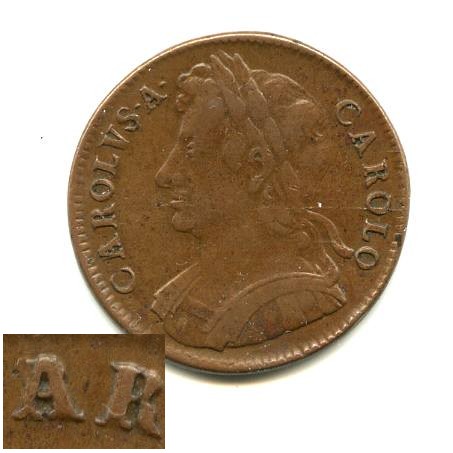
A 1673 1/2d with A/R in CAROLVS, this is not a modified CRAOLVS die. Thanks to Teg for the heads up.
-
Colin had 2 of these. One in gEF sold for £520, one in similar grade to that above sold for £50.
-
and reverse

-
The obverse

-
Practically mint state with almost full lustre, a couple of very light toning spots to both sides and a trace of cabinet friction to the 3 or 4 highest points of both sides. A quality 5/3 by any standard, all over 2 a bonus. No overstruck 1672 examples to my knowledge are known.

-
It sounds like a three-halfpence issued for colonial use and should look as in thislink. They were first issued in 1834 and last issued in 1862 for general use, though there was a proof issue in 1870. 1840 is the rarest and thus the highest priced year for the Victorian pieces. Spink gives 2006 prices of £8-fine, £22-VF, £75-EF and £150-UNC.
-
No definite Soho proof 1807 halfpennies are known, all being attributed to the work of Taylor who had to make an 1807 obverse die rather than modify an existing one as was usually the case due to their absence. To my knowledge, to date, no proposal as to how this was done with proof has come to light. The following therefore is a new variety. Peck on p.383 states that it was uncertain how Taylor concocted the 1807 obverse for the restrike proof halfpennies. The answer is Nicholson 306. Despite having had this coin for the past two years, I only noticed yesterday that the 7 of the date has the features of a 6 on and around it. The actual die used for this pupose is clearly one with the broken jewel bust used on KH35, 36 and 37, but at present it is not possible to positively identify which die provides the definitive link due to polishing and partial recutting. The half way stage between an 1806 proof halfpenny and a die with fully recut characters is therefore an unrecorded new variety. The method used to create the new die was to fill in the 6 (along with other features of the die) and then punch in the 7 etc. This coin provides the link because it shows the 6 detail on the 7 as a result of the initial 7 being punch to less depth than the original 6. This is not seen on restrike 1807 halfpennies as all of the date and legend are fully recut to a greater depth with thicker angular letters and no trace of an underlying 6 is visible, an observation also made by Peck who clearly cannot have seen this piece. The 7 shown below has the underlying 6 positioned slightly higher so that the top of the six is above the 7 and the loop of the 6 is mostly in the angle. This project is currently ongoing.

-
1895 YOUNG HEAD FARTHING
Rob replied to CRAIGSD's topic in British Coin Related Discussions & Enquiries
You will need to register in order to post a picture so that an idea of value can be given. Fair is a grade and not very good so an 1860 bronze farthing in fair would not be worth much. If you mean fair as in pretty good nick it would be worth more. -
Wanted - Montagu Catalogues 4 & 5
Rob posted a topic in British Coin Related Discussions & Enquiries
Unlikely, but does anyone have or know of anyone who has a copy of Montagu sales 4 & 5 catalogues that they would be willing to sell. -
According to ESC in the note at the bottom of page 184 the ordinary 3d's have a duller surface than the maundy money which is more prooflike with highly polished fields. The latter tone more easily and are often bluish or quite dark. Davies says the same thing.
-
1895 YOUNG HEAD FARTHING
Rob replied to CRAIGSD's topic in British Coin Related Discussions & Enquiries
Must be common, even I've got one. -
Yes I am saying that. It is accepted that the rarity of the 1933 is a Freeman R18 based on those 7 examples known, and there is leeway to find more without this changing. The number available to collectors is much lower at 2, so to deface one would merely result in a loss to that person as the other coin would still be very collectable. Given that pieces such as these are often sold privately, it is more a case of right place, right time than the coin having a rational value. Every buyer and seller has an incentive to keep the price moving gently upwards. The 1935 crown rated R6 is the silver proof and the edge error. The basic model is as common as muck. Rayner quotes 714,769 pieces struck. As an aside, Rayner's rarity figures are quite suspect in places and I have heard in passing that he was influenced by a few collectors who doubtless had their own pieces in mind when it came to rarity assignation. e.g. ESC 1067A. I've got one, Colin Cooke had one, Spink are currently listing one on their website, the one pictured in ESC and a few others that I won't bother are more than the R6 rating given by Rayner, and interestingly Peck gave an R rating. Roman 1 1825 1/- is not R7, 1723 C/SS 1/- is not R5, the list is endless. Freeman also makes errors in both directions, so all of these rarity ratings must be treated with a pinch of salt.
-
Oh well I'll go and get the brasso then, that will make it glint. Just a hypothetical question. The 1933 penny is worth £30-40,000. The owner likes to keep his coins nice and shiny. As there is only one know in private hands would a drop of brasso actually make much difference in its value. Discuss. Gary £45K actually based on Mark Rasmussens list. The collector who bought it would not be interested in cleaning it and would leave that decision to the next owner, so the problem is purely hypothetical. Coins are only polished by those who know nothing about collecting. Should such a lunatic use Brasso, its desirability would diminish and be replaced by another rare coin and therefore I would expect its value to drop.