
Rob
-
Posts
12,976 -
Joined
-
Last visited
-
Days Won
387
Content Type
Profiles
Forums
Events
Downloads
Store
Gallery
Articles
Everything posted by Rob
-
Henry II Tealby Penny: Attribution help requested
Rob replied to Overlord's topic in British Hammered
The mint signature is certainly CANTO at the top of the rev. picture because there is no sign of a termination. Where it would be is flat, and it doesn't matter whether it is a colon or initial cross, it ain't visible. RAVL is a distinct possibility given the width of the A. I'll bear that in mind. If the curl inside the C is an R tail, we are halfway there. The following A would be super-imposed on the A of the moneyer name, so possible slightly different profile given the possibility of made up letters from lines, crescents and wedges. The mint signature looks to cover about 150 degrees of the legend -
Henry II Tealby Penny: Attribution help requested
Rob replied to Overlord's topic in British Hammered
I think Alferg is only known for Bust A and this is Bust E with the hair curl, drapery joined at the left shoulder and a single row of pellets with pellet below. It doesn't look like E1 as there is no obvious triangle of pellets below the collar, so probably E2 or E3. All with the caveat that it is clearly double struck. Mint reading is CANTO, which should mean a shorter name. I'll try to dig out Allen to see if there is a die match when I clear the crap off the floor. The key will be the relative positions of the sceptre, + and hEN if there is a die match to be made, and a lot of reverse dies can be eliminated with the long mint signature. -
Yes, but the big difference there is that the gilt pieces are patterns or proofs and so readily distinguishable from the currency issues. This one looks to be a normal worn currency piece that someone has had fun with. The weight is likely similar to what it should be. Silver is only a bit denser than copper, so the wear will likely cancel out the difference at best.
-
You sometimes get silvered base coins for use as a pendant or similar. I see yours didn't have a hole for suspension, but the intent will likely be the same. If the silver is recoverable as part of a bigger lot, then best recovered that way, but sadly no or very little collectable value.
-
The collection was sold through DNW in conjunction with Stephen Mitchell, who was a favourite dealer of John's with many supplied through that channel. Apparently a box was dropped when picking up the collection. It isn't impossible that it was lost at that point, even falling through the drain grid. A metal detector around chez Hulett (decd) might be of use, but a bit of a bummer though, if it was lost at that point.
-
Variation on a theme here. One lot I had won in the Hulett sales came with a ticket that was for Brooker 613 (6d mule with the obverse mark Crown over Bell over Portcullis) and to my knowledge is the only one known. I had marked that as a buy when it appeared, but the ticket (613) was for a different coin to the one I bought, so dutifully sent it back to be reunited with the right coin. However, the coin I really wanted didn't appear in any sale as far as I could see, so where is it? I know John had Brooker 613 because I saw it when visiting on one occasion, hence the interest. Humpf.
-
The heavily gouged parts of the reverse are presumably where it was in contact with or in very close proximity to a different metal to set up the electrical circuit. Despite that, you can still see your own reflection clearly in the unaffected parts of the field, which remarkably, are still like mirrors (both sides). Of far greater importance is the context. i.e. It is a missing link which logically should exist given the existence of the copper analogue. As a coin which fills the gap, it is more important than the condition.
-
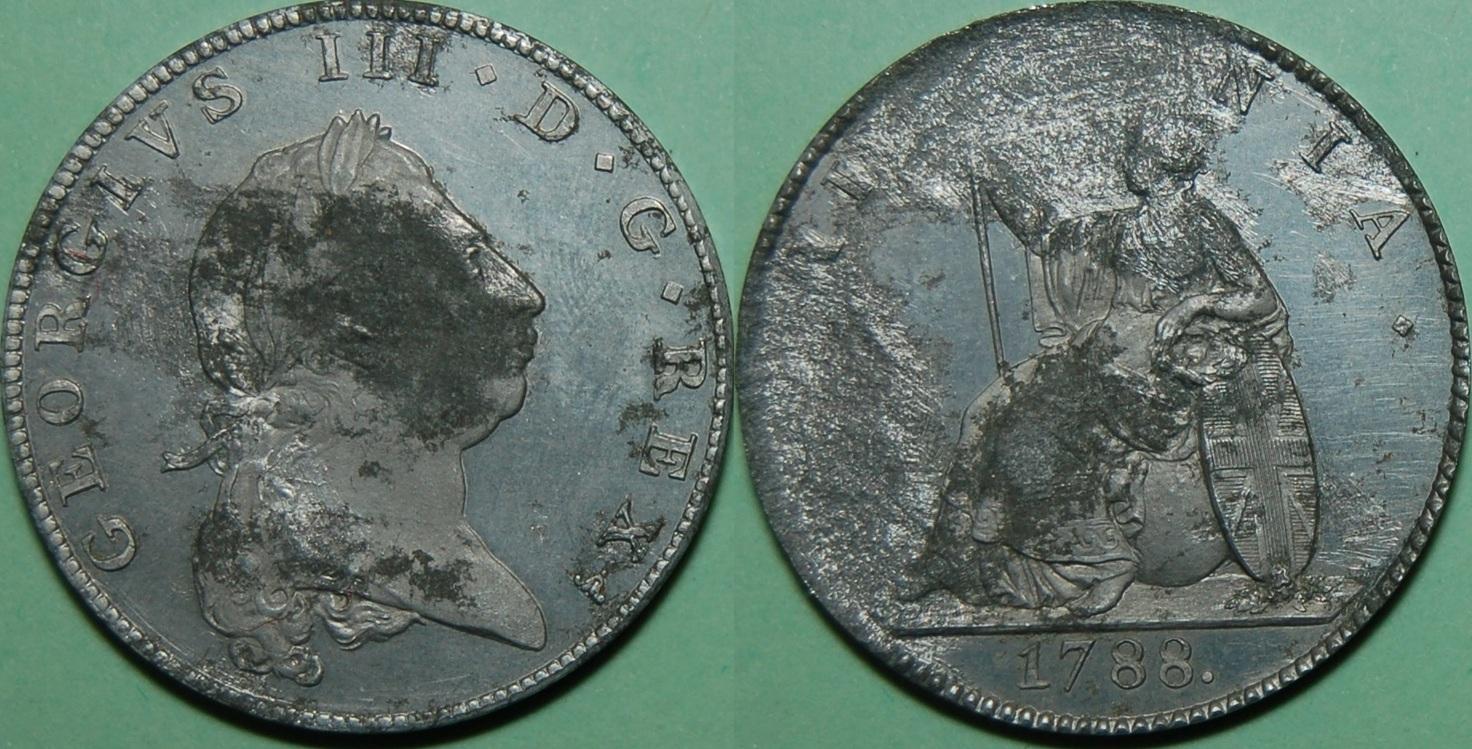
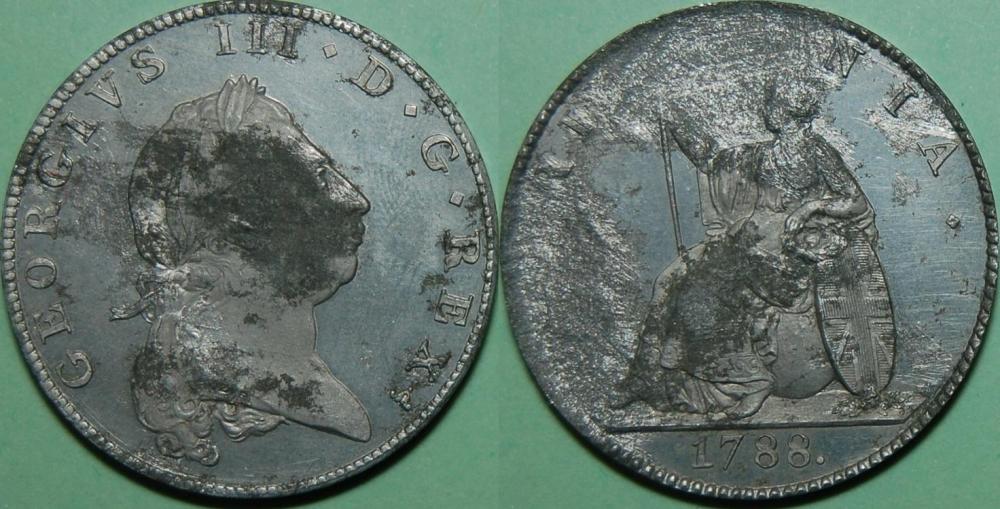
Only halfpennies as it is a legacy collection. Basically I couldn't bring myself to do too much pruning as they were (mostly) too nice to throw out. And I couldn't see much point in getting rid of the unique dogs, such as the attached. An R24 in Aluminium - one that should have existed based on Peck's groupings, but he failed to locate an example. I suspect this was with a group of related aluminium die pairs at Spink when their building was bombed during WW2 and the corrosion is from water/electrolysis, as others within this group and struck in aluminium are similarly affected by water damage, albeit not as badly. See the Glens sale in the 60's or Selig's collection for other group examples. I picked it up on ebay in 2009 from the US - surprisingly nobody wanted it given its id but thankfully the condition eliminated the number chasers, so cheap as chips. . Happy days. Pennies, farthings and twopences are satisfied by an example of each type of style, rather than the nuclear option. Funds are too limited to go ballistic on all fronts.
-
I used to collect halfpennies and shillings as denominations, so the accumulation of Soho patterns was inevitable. I have however tempered my habits and now only 'need' an example of each Peck die pairing in whatever metal, as opposed to all die pairings in all metals.
-
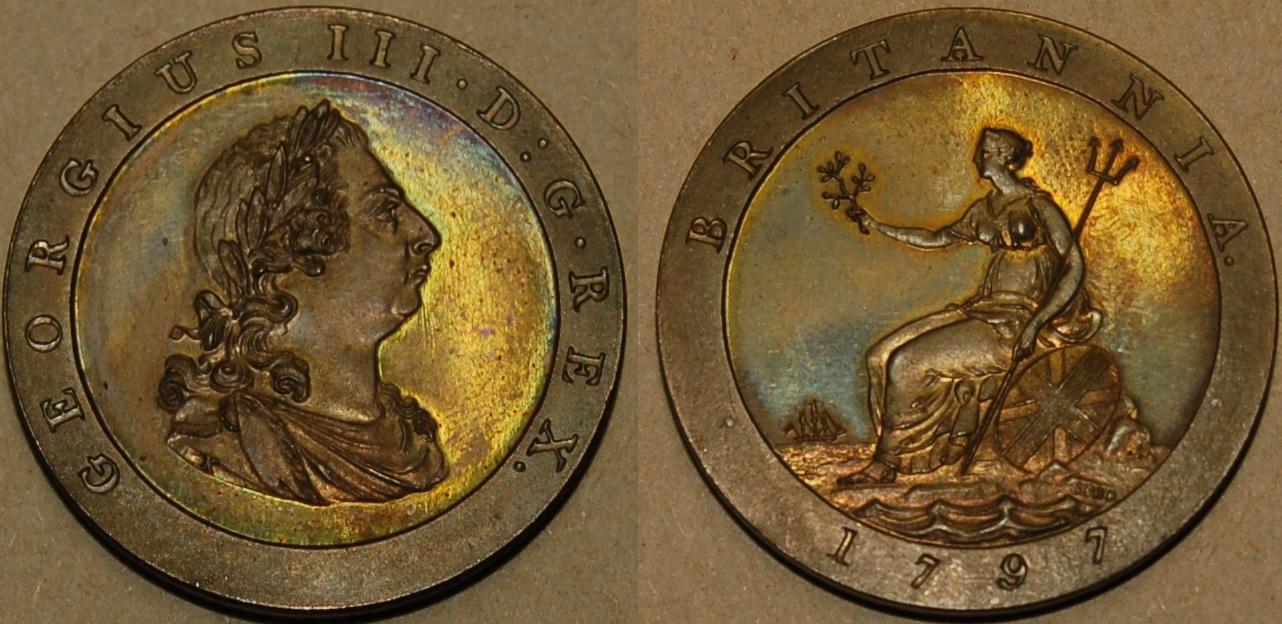
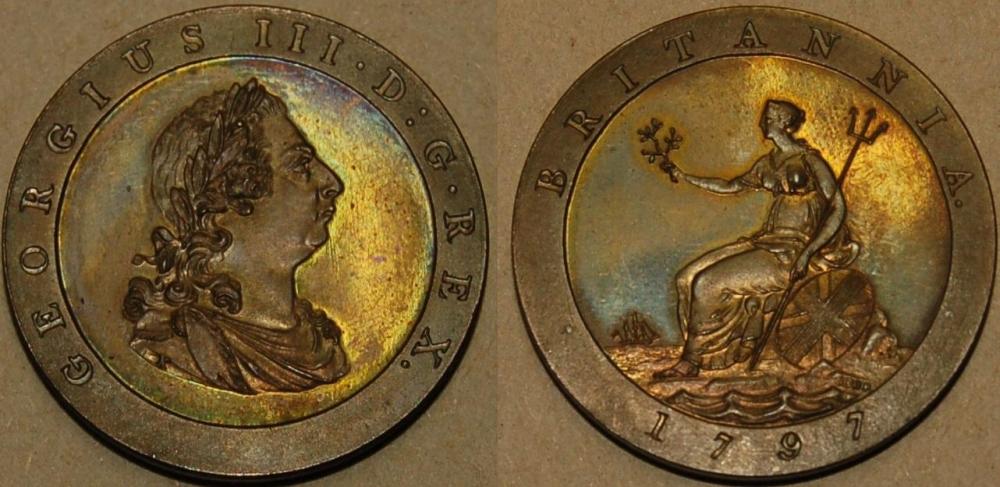
Silver is always going to be better than gold for toning, due to the latter's relative resistance to chemical reaction. Toned gold is usually due to the copper mixed to produce the correct fineness. As you will be aware, left to its own devices and in a fairly clean environment, it will mostly turn black from silver oxide. Establish what the chemicals responsible for the colour scheme were and you probably have a good indicator of London's atmospheric constituents since Victorian time, though the toning stripe that looks like Britannia let one go, is probably from the fabrics found in a mint set. Though as always, a lot depends on the angle of the shot relative to light source. 15 or 20 years ago, I posted a picture taken one sunny day when I had a tray of Soho patterns on the desk, and the various colours reflected onto the ceiling enabled me to individually identify all the pieces using colour alone. There was a mixture of copper, bronzed, gilt and silver, but all were distinctively coloured. I think I lost the image a few years ago when photobucket went dysfunctional, so will have to wait for the sun to make another appearance unless someone can locate it on the forum. Having said all that, the one below is an oil painting in most lights and from most angles. Apologies to those who have already seen it.
-
Not seen it. Thankfully our TV has been on the blink, losing signal sync recently and giving us both the opportunity to not bother filling our minds with garbage. Maybe a repair tomorrow.....
-
How are you supposed to 'train' a system specifically designed by people whose companies want to rule world, even if using dodgy info to learn that WRL stands for a small niche in numismatics called COPIES. Fake news mostly exists in the minds of people involved in the dissemination of said 'sh**e'. When all info is legitimate learning material, misinformation is reported as accurate if more people say it's ok than call it out for what it is. It's called rewriting history. Sane members of humanity are encouraged to keep as much contemporary written material as possible to negate the anticipated rewrite courtesy of today's dictators/autocrats/snake oil salesmen who are doing things to benefit their control over the peasants. As the one balled former Chancellor of Germany showed a century ago, the people will accept lies if repeated often enough. A premise the current heads of 3 superpowers are using to this day. He did not have copyright on the technique.
-
I can only suggest that when a brockage happens, the press is full of unwanted metal which in these cases shattered one of the flans with the remnant causing what is seen. The offending item did not bind to the full flan and fell off. It doesn't look concocted in either case, as the incuse legends are approximately correct for orientation, albeit displaced significantly in the first one.
-
I can understand the logic of considering the lack of stops by the mark of value as a true variety as they provide a finite area for visual confirmation of the coin's face value, making it very difficult to add extra strokes to 'increase' its value. Given the random weight distribution at certain periods in history, this would provide some reassurance as to what it was. Urban myths are not a new thing. Edited to add, I think the right hand pellet is on the left hand side of the vertical light area, but the left hand dot isn't clear on my screen. It is also important to remember that dies were normally recut after the old one had been rubbed down, meaning it could show old detail anywhere on the flan, or not depending on where it was re-engraved on the die stock. The die shaft was not necessarily the same diameter as the coin being struck.
-
Stuart. For your own sanity, stay calm. Jackson - Kent spent 10 years analysing the string numbers on W3 coin harps only to conclude at the end of it that there was no significance. Personally, it makes more sense for the stops to be personal privy marks as an engraver id, as there are a number of types used, but thick string or thin string in varying quantities is never going to fly given die degradation. Stops however, are rarely confused.
-
Not rare, so how many would you like? Value, £2 face but little if any in a premium given the 2 black marks on the reverse and numerous obverse bagmarks. Somebody desperate for an example might pay £3, but not likely.
-
Theories as to what's happened with this penny?
Rob replied to RChris's topic in British Coin Related Discussions & Enquiries
It is the rim metal covering the legend that gave me the response above. It may well have been both processes to clean off any surface marks from cooked material in the mould (if cast), with force applied (?) to produce the inner ring. I'm struggling to reconcile the ring lip with a linear circle, as it would have to impinge on the legend too as seen. Only the person responsible for it knows the truth. -
1945 Penny - Thin flan
Rob replied to Accumulator's topic in British Coin Related Discussions & Enquiries
If you consider what a flan is, there is an underlying crystalline structure based on the metal in question. At the atomic level, the atoms are connected by well defined structural links via shared outer electron pairs. In a perfect piece of metal with no inclusions, this would be consistent across the entire surface. However, at the next level up, the surface is disrupted by metal flow when struck leaving small sub-micron cracks. A crack is a crack and therefore will allow a greater surface area to be exposed to any reactant. One thing I have noticed with seriously corroded coins at the date for example is a 'moat' around the digit where the metal has been more rapidly removed than one might otherwise expect. I acquired and sold one 20 years ago, but can't find the image. This I would explain by the cracks allowing the reactant to penetrate the metal and so lead to increased metal loss at these points. To compare with toning, which is only another form of altered metal surface, not involving metal loss, you regularly see more toning around the relief detail. Again, I would put this down to the stress cracks allowing greater reactivity with the atmosphere. eg. see below. It is posted elsewhere, so apologies, but does demonstrate my theory very well. If metal is going to react, it doesn't matter much whether the fluid is a liquid or a gas, as both will cause some effect if chemically possible, just the rate and effect will vary.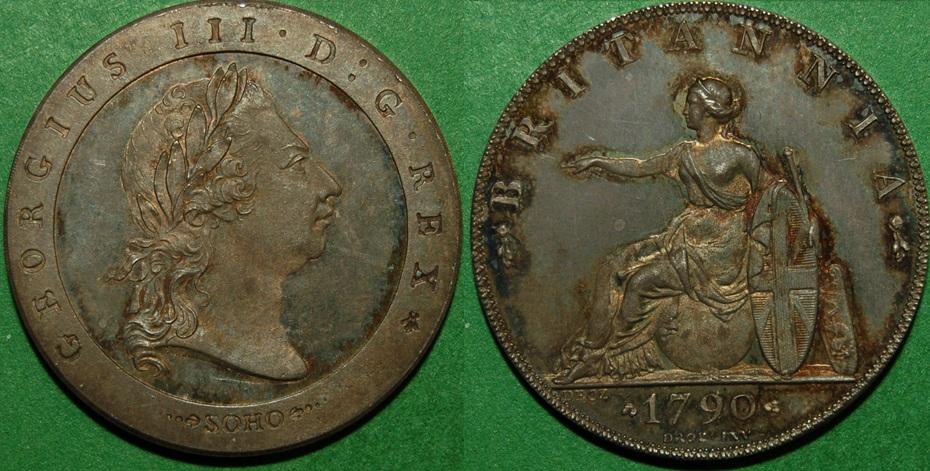
-
Theories as to what's happened with this penny?
Rob replied to RChris's topic in British Coin Related Discussions & Enquiries
The visible lettering is too crude and close to the rim IMO. It looks more like an abused attempt at a cast copy to me. Any attempts at acid cleaning will thin the letters and reduce dimensions on all 3 axes if there is total immersion. The weight of a cast would obviously depend on the amount of metal poured into the mould, so I think not relevant in this instance. -
Because they know no better and want to believe what they see. Unfortunately, knowledge requires some input from the prospective purchaser in the form of reading up the subject before buying. To me and you it is simple, but that's because we are interested in the subject matter. For the uninitiated just randomly looking for things that appeal visually, it's not a great step to hit the buy button. Sad but true. Ebay can't police the content sufficiently to make a difference, so once again, it relies on the moral compass of the seller. There should be a useful statistic in there somewhere for a number for Mr. Average's honesty coefficient, not to mention the gullibility coefficient of the typical buyer.
-
Have to confess that I was only interested in a couple of milled patterns, so wasn't paying much attention other than to note they were expensive. However, I did get both Martlet/CLH 1550 shillings though (lots 13 & 14) at some cost. Both typical Ed.VI dogs in terms of quality, but happy with the pair.
-
Ink printing on a silver coin ? Victorian 1883 3 Pence
Rob replied to Citizen H's topic in Free for all
In the case of written text, I suspect it may have been underneath a piece of blotting paper or at least something as adsorbant as bog-roll. That was the only way I could rationalise my 1773 halfpenny on a spread flan with Basing House plus some indecipherables written in the hand of H Webb. The above could equally be due to someone making a poster. Anything written or pressed onto newsprint with excess ink is likely to pass through quite easily given the paper quality. -
Worse still, looking back, it appears I also posted the Truro and B a year ago too. I claim mitiga...... Actually, I had just started to dig into, photograph and update the collection database which hasn't seen anything new for the past 12 months despite a few dozen acquisitions since then. Must do better.
-
Well spotted Mr G. Maybe my kids weren't so silly to suggest I sign up for the Biobank Alzheimers Accelerator Project after all. TBH, I'm not sure it needs to happen quicker anyway, but hey-ho. I had completely forgotten about that, but claim mitigating circumstances as I had just driven to the other end of the country through the night to look after the grandkids in Plymouth due to a family bereavement on the other side and not bothered going to bed afterwards. Hopefully get some sleep tonight when I can switch off.
-
Sorted then. Well done. Those who don't like keeping reference books/records, please note.