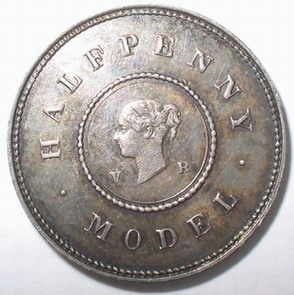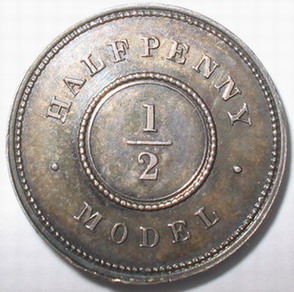

Bronze & Copper Collector
-
Posts
1,434 -
Joined
-
Last visited
-
Days Won
33
Content Type
Profiles
Forums
Events
Downloads
Store
Gallery
Articles
Everything posted by Bronze & Copper Collector
-
 Here's hoping that someone can help me out.... I have a 1967 penny struck on a 6.3 gram planchet... smaller than a penny planchet and larger than a half penny planchet It appears to be 28-29 mm in diameter.... also slightly thinner (maybe 3/4 normal ??) See attached scans.... one each of obverse & reverse... the 3rd is of a normal penny on the bottom, this coin in the middle, and a normal half penny on top.... I would assume that this coin was struck on a planchet intended for a foreign coin that was being struck at the Royal Mint.... Does anyone have any ideas as to what this planchet was originally intended for???? Thanks


-
Additionally and simplest, on the reverse of 1922, the center trident tine touches a border tooth.... On the reverse of 1927, the central trident tine is below the border tooth... see attached images.... Type of 1922 ------Type of 1927


-
I was re-examining my F-279's and found an overdate.... which I had not seen on a reverse F as yet.... see scan below of 1861 F-279 Last 1 over Lower 1 .... a very distinct lower 1 is visible.....

-
A few hours behind indeed...... but you still caught me with enough time to spare.... MANY THANKS for the kind sentiment..... Regards, Gary
-
1957 1/2d 7 to gap
Bronze & Copper Collector replied to Gary D's topic in Confirmed unlisted Varieties.
I'm not sure if I have attrributed these correctly, but one sure looks blunter than the other.... I think I have types 1, 2 and 4 see attached scans...... opinions???? I'll list them in separate posts as the names and attributions are not apparent.... I've edited the images with the type so that you can see which I think is which.....


-
I have seen and/or owned a few (2 or 3) examples of Obverse 5 WITHOUT the flaw.... ALL were 1860 however...... Freeman even mentions that MOST obverse 5's exhibit this flaw.... (most NOT all) Possibly the flaw developed early in 1860 and carried on into 1861???? a weak premise that an unflawed obverse 5 from 1861 would easily disprove.....
-
1861 Halfpenny, help wanted
Bronze & Copper Collector replied to Gary's topic in British Coin Related Discussions & Enquiries
I found an old close-up of the F-278 that I had sold 2 years ago..... see attached scan.....
-
1861 Halfpenny, help wanted
Bronze & Copper Collector replied to Gary's topic in British Coin Related Discussions & Enquiries
Neither of my 2 F-268A's appear to have a recut 6..... However 1 of my 4 F-278's have a recut 6 as well as a specimen that I sold awhile back..... and 2 of them appear to have a stub of a previous 1 protruding beneath the last 1 ... see scans... None appear to have a recut R though..... nor a first 1/1

-
Possible, although the only clear incuse lines are on the bottom 4th. The flaw in the forehead also raises questions as this is obv. 5. Do you have a well struck mint state obv.6 to compare with? I only have an EF and on that piece, although it fits obv. 6 in all other respects there is no sign of incuse lines for the leaf vein at all on the upper leaf of the 4th group. There is however a trace of raised leaf vein - sort of obv.5 3/4 if you see what I mean. There is only a trace of wear to the highest points and none on that leaf, so rubbing isn't the problem. True enough, but I am reasonably sure that this is NOT an Obverse 5 because it does not have the scalloped top middle leaf that EVERY Obverse 5 (flawed or not- I have seen examples of both) that I have seen exhibits, and that I have NEVER seen on any obverse other than an Obverse 5..... (see scan)... Unless of course, this is some interim Obverse 6 variant, that eventually became the obverse 6 in 1861.... I don't have the obverse 6 coin mentioned in Iain Dracotts article for comparison..... It's possible that it is some sort of hybrid obverse spanning the 2 years (1860-1861) I would certainly suspect that this coin is closer to the Obverse 6 than to any other obverse, so given the information available, and the condition of the coin, I think that I would have to classify it as an Obverse 6 (maybe with an asterisk denoting it as a possible minor variant or precurser to the accepted obverse 6) And again, photographs can not substitute for direct examination....


-
I believe I might have found a lower grade, yet identifiable Obverse 6, Reverse B Half Penny...... Freeman does not list an Obverse 6 for 1860, although Iain Dracott does mention a specimen (listed as Unique).... I have attached images for your perusal...... Obviously still not as good as direct examination, yet I believe it is clear enough......


-
Victoria Bronze Farthings.
Bronze & Copper Collector replied to Gary's topic in British Coin Related Discussions & Enquiries
F-542 = 1880 5 & D Bronze Proof----- R-19 1970 Edition...... Both my F-525 and F-527 appear to exhibit this feature....... -
1875H Farthing Freemans, Rev C
Bronze & Copper Collector replied to Gary's topic in Confirmed unlisted Varieties.
I think it is an F-532 It also appeaers to have a recut "T" in farthing.... -
Another valid reason Rob, and one which I would not dispute either...........
-
It's possible that they do it on some level to "hook people in"..... However, I think a more important reason that auction houses might underestimate the estimates is that, when the final hammer price far exceeds the estimates, they can claim either "how hot the market is, it's a great time to sell", and also to claim how successful they are at sales/auctions/etc, and that THEY (the auctioneers) are the company that you should use...... There are probably other aspects as well, but this, to me, is one of the most obvious.... Incidentally, I feel that in the DNW sale today, some items went rather cheaply, and others brought a significant premium....... I do note however, that the TRUE CLASSIC RARITIES brought excellent prices.... which is how it should be..... Those are ALWAYS in demand......
-
I finally got the confirmation.... I was the winner on the one coin that I wanted...... Now to wait for it to arrive.......
-
There is always the case of the 1963 proof 70 deep cameo slabbed by pcgs that sold for $40,250 in 2004 Heritage http://coins.heritageauctions.com/common/v...336&Lot_No=4944 It subseqently developed spotting in the slab and was bought back by PCGS....... It's a HIGH premium for a common coin, just to say you have the finest known specimen... The grading fever can and does get out of hand all too often, but, as I have said before in other threads, certification does have its benefits, especially regarding detection of counterfeits and altered coins, something that occurs too often with rare date US coins, but not as predominent with GB coinage yet... a few dates not withstanding.....
-
I had emailed the 3 sellers that I knew.... and also contacted ebay directly.... They too contacted ebay...... as of now, fast by ebay standards, the fraudulent seller is not-registered any more... and has no items for sale..... score one for the good guys........
-
I've emailed ebay with several of the ripped-off links.. AND informed some of the sellers that their pictures had been ripped off and are being used fraudulently...... I doubt that Ebay will do much on my information, but hopefully, after the genuine sellers complain, they will be removed.... Let's see how promptly ebay reacts.... Good rule of thumb: "If it seems to good to be true, it is"...... Caveat Emptor..... Use common sense.....
-
R over G?
Bronze & Copper Collector replied to Hussulo's topic in British Coin Related Discussions & Enquiries
Not familiar with half crowns (primarily Bronze & Copper), but insofar as regarding overdates/repunches, etc.... But for my 2 cents worth, it certainly has all the appearances of being that variety.... -
Q. David Bowers once wrote an article regarding exactly that...... Two coins, maybe a grade or so apart... the lower grade having more eye appeal.... He would go for the eye appeal every time... and I would tend to agree......
-
1844 Farthing
Bronze & Copper Collector replied to RLC35's topic in British Coin Related Discussions & Enquiries
I would concur with the above assessments.... -
I Bid on one coin... Am still high bidder on the item.... Bid amount went up though.. So I know there has been at least one other interested party..... Still waiting for finalization........
-
victorian model penny
Bronze & Copper Collector replied to a topic in British Coin Related Discussions & Enquiries
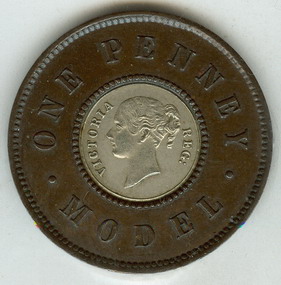
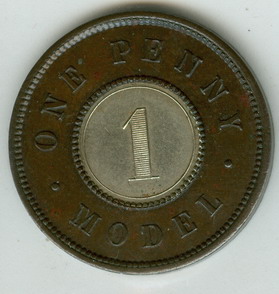
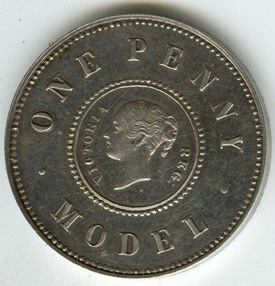
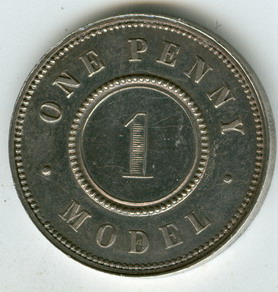
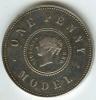
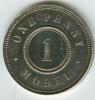
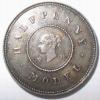
This is an example of the PENNEY error mentioned above...... Here are the other rarities.... A model penny (F-799) and half penny (F-804) in silver ...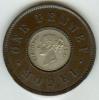

-
Agreed, It's vital that a collector learns how to properly grade..... To examine the coin and not accept some third party's decision.... I have seen many instances where a lower graded ccoin was more attractive that a coin that was certified at a higher grade.... Eye Appeal is important too..... My point was in the detection of counterfeits and altered coins...... A problem that proliferates here in the US.... I don't think that there are too many instances of phony rare dates around in GB coinage except for maybe the 1905 half crown and coins of that ilk.... Using the 1905 as an example, specifically, thre was a recent post regarding a specimen in one of the forums here as to whether it was genuine or not....That is one instance where a third party service can be of some use.... A collector may be able to GRADE the coin properly, but NOT have the equipment to detect a counterfeit..... The bottom line is, a collector should KNOW his/her coins (or whatever), and use EVERY TOOL at their disposal to make determintions regarding their collections. And a third party service should be considered just that, another tool, to be used if and when necessary, as an supplementary aid to the knowledge that they already have..... (again, the caveat would apply, that the US grading services know more about US coins thann GB coins, especially regarding varieties.... HOWEVER, an counterfeit and/or altered coin is still just that, and they have the tools to make a final determination....) I'll sum up by saying that I still prefer to place the coins in an album (there is nothing quite like viewing an album and seeing that all the holes are filled..... There is a sense off accomplishment about that that is very satisfying), BUT, with the higher prices that US coins command, it becomes necessary to use every tool available to help detect and combat the invasion of counterfeits that exist. The GB collector has fortunately NOT been exposed to that seedier side of numismatics yet, but an informed collector is a smart collector..... Thanks.... Another purpose that slabbing can serve, is to provide a safe INERT environment to store your coins ... This is really only applicable to EXTREMELY HIGH GRADE specimens that are highly subject to the environment......