
Peckris
-
Posts
9,800 -
Joined
-
Last visited
-
Days Won
53
Content Type
Profiles
Forums
Events
Downloads
Store
Gallery
Articles
Everything posted by Peckris
-
Your coin is most likely to be an 'antoninianus', which was the equivalent of the silver denarius in later Roman Imperial times. Essentially it was a bronze coin that was just washed with silver, and nowadays turn up anywhere from fully silvered to just bronze or any stage between.
-
Upcoming auction for unique celtic iron age silver unit
Peckris replied to little-treasurez's topic in Ancient Coins
It seems it is a rare item. -
Upcoming auction for unique celtic iron age silver unit
Peckris replied to little-treasurez's topic in Ancient Coins
From my memory of Roman history, and the letters SABIN on the obverse, it could be a commemorative of the rape of the Sabine women? The reverse appears to show women being carried off. Apart from this, I can't help much. Here's a similar item on eBay - it seems my hunch was right: http://www.ebay.com/itm/Roman-Republic-Sabinus-89BC-Rare-Silver-Ancient-Coin-Rape-of-Sabine-i28426-/230811767964 -
The problem with the shuv--ha'penny theory is that it's always the reverse that wears flat - obverses (Ed VII Geo V) were rarely worn that badly, and were a grade and a half better at least. The real cause of the problem was 1) the depth of the Geo V portrait and 2) the shallow reverse rims. Rims were better on pennies and farthings which didn't suffer so badly.
-
Yes, very much better IMO. It looks more naturally toned. Certainly a GVF obverse, I'll wait to see the reverse.
-
Types, Varieties & Micro-Varieties!
Peckris replied to Coinery's topic in British Coin Related Discussions & Enquiries
I'd repeat what I said a few years ago in relation to 1957 halfpennies, if anyone is interested: I would regard the 1957 'calm sea' 'wavy sea' varieties hover between major and minor - yes, you have to look at just one feature (the waves), but it is a glaringly obvious difference in my opinion and I'd personally rank it as a major variety. What I would term 'micro' are the precise differences between the ship on the reverse of each date of Elizabeth II halfpenny. Each one is a minutely different size, but not interesting at all (to me, anyway). As for the precise position of the 7 in the date on 'calm sea' halfpennies, that seems the ultimate in 'micro' to me. -
Cashing in predecimal coins
Peckris replied to zero's topic in British Coin Related Discussions & Enquiries
My understanding - correct me if I'm wrong - is that banks won't take them, but the Royal Mint still will. But probably not worth it unless you have quantity. -
"retaining much originality"... Er, what, exactly?
-
You could try washing it GENTLY in pure soapy water and a completely non-abrasive cloth (micro-fibre, like they give out with spectacles), then wash and dab dry with a clean towel (don't wipe dry). It that makes little or no difference, come back and ask what your next options are. I agree with the GVF/NEF grade. but only for wear not for eye appeal, which as has been said, is limited.
-
Bun pennies would quite often turn up in VG, usually dated between 1889 and 1892, or 1875. Pre-1925 halfpennies would often have reverses no better than Poor, or even flat, so bun halfpennies were probably mostly withdrawn. It did make my finding a 1909 halfpenny in GVF+ rather special though.
-
Liverpool man invents new currency...
Peckris replied to Michael-Roo's topic in Nothing whatsoever to do with coins area!
Talking of Liverpool men... What's the difference between UKIP and a toilet? A toilet has a seat! -
-
Mrs peter and her best friend
Peckris replied to Peter's topic in Nothing whatsoever to do with coins area!
He's done a whole series of these! Just Google and see what he turns Night Fever into... -
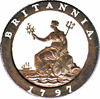
Under £1k? Ok, here goes (though 5 is a bit limiting!): 1. 1797 cartwheel twopence, or one of its proofs 2. You won't get a Vic Gothic crown, but a BU florin would be a good consolation 3. A BU bun penny, preferably from the first 4 years (v expensive otherwise..) 4. A BU George V wreath crown, or the 1927 FDC 5. A BU 1949 brass 3d But there are loads of other options. E.g. an Edward VII BU halfcrown, and there's his florin too.
-
Ha, true! I just like the way he threw Mrs May's Brexit mantra back in her face.
-
I started collecting pennies as a schoolboy in the 60s. The elusive date was 1926. Finally got one in change from a bus conductor. I was a raw beginner, and it was nearly a year before I realised it was the ME variety.
-
At first glance I would say from the reverse that it IS a matt proof - it has superb overall detailing. Harder to tell from the obverse, as it seems to have been cleaned, which is a real shame. I think it IS the proof though.
-
Hi and best way to get latest commenmorative releases
Peckris replied to MarkM's topic in Beginners area
Damn the truncated summaries of a post's title on the right! All I saw was: Hi and best way to get la I was really hoping for something interesting, or at least a few tips. -
Tim Farron, asked about the likelihood of the LibDems accepting the offer of a deal with the Tories: "No deal is better than a bad deal".
-
Fake 1923 Halfcrown?
Peckris replied to youliveyoulean's topic in British Coin Related Discussions & Enquiries
Yes, the obverse is a crown, not halfcrown. I remember once getting very excited when I saw a 1928 penny on eBay with large portrait - that's until I saw the same seller had a 1927 penny with small portrait. -
What do you mean "up side down"? Do you mean that if you rotate the coin horizontally, the reverse is upside down compared to the obverse? If so, that's how it's supposed to be.
-
Wow. Doesn't surprise me though!
-
There are three factors that must be taken into account to value a coin: condition rarity popularity The third is as important as the other two. It explains why 1933 pennies - which are not only very rare, there being only 7 of the normal type, but also have a legend around them - would now fetch probably 6 figures if one came up for sale; compare this with possibly unique proofs of Victorian bun pennies which might fetch a few thousand if you're lucky. It also explains why fairly common or mildly scarce coins like 1912H pennies or 1902LT pennies fetch prices well in excess of their rarity. As for the first year of a monarch's reign, these are generally lower in value than rarity might suggest, as ordinary non-collector members of the public would put specimens aside for their novelty, and so they survive more commonly in high grades than do later years.
-
1861 penny / micro pics info
Peckris replied to chadcoins's topic in British Coin Related Discussions & Enquiries
Not so much an error, more likely a repunching of weaker letters. The Mint had very many problems with the early bronze coins, so this is an effect you often see. -
1970 & 1971 Proof sets help
Peckris replied to pokal02's topic in British Coin Related Discussions & Enquiries
"Sold FROM 1971" I would say - as Copper says, the 1970 set was very popular (and still is) so they carried on minting them up to the issue limit of 750,000. Its popularity is not surprising considering it was the only proofs of the main Elizabeth II post-1953 type, and was of the vanishing £sd coinage. Several of the 1970s sets contain 'proof only' denominations, which might have made them more desirable to collectors, especially the 1972 set. However, it's likely that a 'modern collectors' market - i.e. decimals - was already developing then, as Coin Monthly seems to show little interest in UK decimals even by 1975, and doesn't even feature 1970 proofs in its Market Movements. (I don't think you would have bought the sets in 1975 - certainly not before the preparation of Seaby 1976 - as there is no mention in Seaby of anything post-1971 under Proof Sets. Unfortunately Seaby took a break of a few years after 1976 so we can't date them precisely unless someone has coin magazines for the period 1976-1979?)