
Paddy
-
Posts
2,315 -
Joined
-
Last visited
-
Days Won
172
Content Type
Profiles
Forums
Events
Downloads
Store
Gallery
Articles
Everything posted by Paddy
-
I would message the seller, but with a feedback of zero and such a cock up of a listing I cannot imagine they would respond.
-
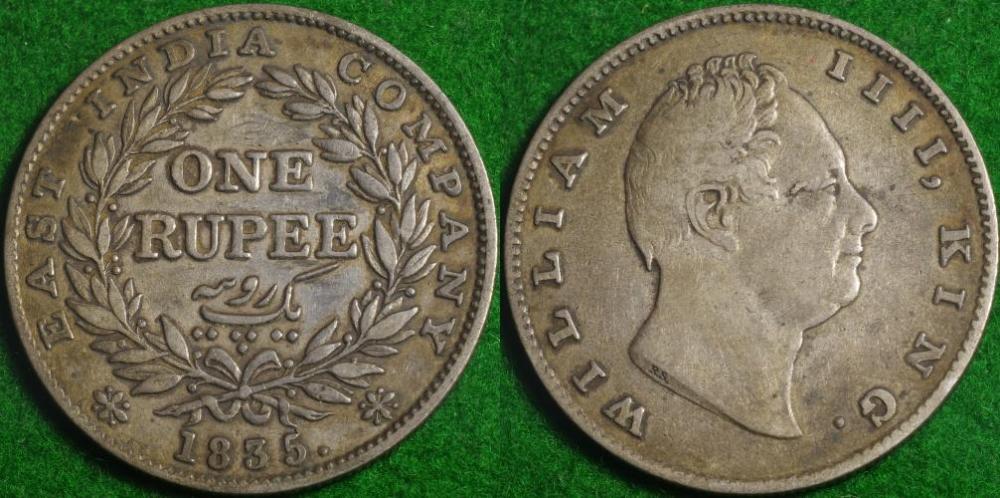
I only have one these days. 20 years ago I bought a whole collection of Indian silver including several dozen assorted Rupees, but sadly I sold them all. This is William IV, 1835:
-
Arrrgh!
-
I wonder whether Gundry relates to the "Bridport Gundry" rope and netting company? I visited them with my father, when he was on business there, in the early 70s, but I believe they are no longer in operation. It was fascinating to see the rope making process and the number of different uses rope and netting could be put to!
-
 Welcome @David WSGG. I can't see anything wrong with your coin, so I would say is genuine. Die numbers are a bit of enigma. The lists that have been generated are not from the RM and merely represent those that have been identified by various collectors. As has been discussed on here before, the lists are not expected to be exhaustive, new ones are occasionally being found. There are not many ardent collectors or collators of die numbers, so a new discovery does not create as much excitement as a new variety of, say, a penny. I believe the list you have referred to is this: https://www.coins-of-the-uk.co.uk/dieno.html which does indeed miss out the 32 for 1873. Tony Clayton, who runs this page, would probably be the most interested in your discovery, but I can't seem to find an email address for him on his pages. Maybe someone else on here knows it? Ah - just found an email: tony@tonyclayton.org.uk
- 3 replies
-
- 1
-

-
- genuine example
- shilling
- (and 3 more)
-
I have messaged the seller - we will see how honest they are. I suspect the "Customer Service Person" at Ebay was an AI bot!
-
help Help needed identifying a set
Paddy replied to Elmo's topic in British Coin Related Discussions & Enquiries
Welcome @Elmo to the forum! An interesting set and intriguing that it is so difficult to find on the net. Individual coins are mentioned on Numista: https://en.numista.com/182480 but they would not list full sets anyway. Not sure we have many members here who are into Chinese coins as our focus is on British issues. It might be worth posting your query on Cointalk at https://www.cointalk.com/forums/world-coins/ as I know they have quite a few Chinese and bullion coin collectors there who may be able to help you. -
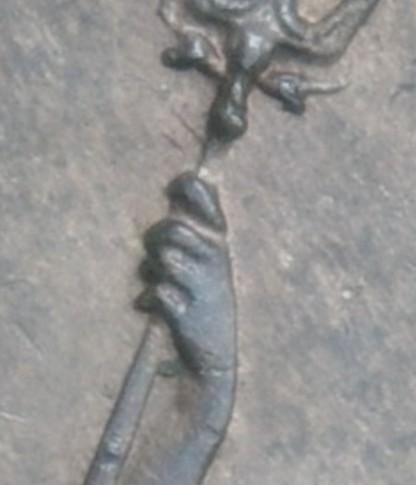
I recall that in 2016 and 2017 the new £1 coins appeared with a variation in the rim. The milled section at the base of the portrait could be either left or right of the point of the neck and I think lefties were deemed scarcer. From 2018 they seemed to have sorted out the error and all coins were Righties. However, I have seen that the 2025 £1 occurs both Leftie and Rightie. I wonder if this is really an error, or will be another Ebay fad.
-
Mine matches the left hand version and @secret santa's, so I guess is the normal one:
-
Yes, I am not sure where AI came up with "Arabia Shelf" - makes no sense from what I know of Ancient history. I think the reverse legend starts "DEM..." so could be the Greek Goddess Demeter? but it may be "DEMNA.." which I can't relate. (The H is the Greek letter Eta - a long ee sound.) The only book I have on these is "Greek Imperial Coins" by Sear, but it has few illustrations and rather assumes you can read most of the inscription!
-
I always like to see them, and have got better at Identifying them, but I have resisted collecting them. That is one huge rabbit hole to go down!
-
I think I can see the remains of "IMP TRAIAN ..." on the obverse, so Trajan? Reverse legend seems to have some Greek letters, so possibly Roman provincial.
-
Yes - 'fraid so! Wallowing in the luxury of retirement now.
-
When I had a market stall 5 years ago, this one seemed to be the least common of the Shakespeare series and commanded a slight premium in top condition (£4-5). I suspect a batch has recently come out of the Royal Mint's back log of £2 coins as a number have turned up in change.
-
Welcome @perry123986cook to the forum. 2008 was the year of the change over from the portcullis design to the broken shield issue. See https://www.royalmint.com/collect/collector-resources/uk-coin-mintage-figures/1p-mintage-figures/ for the figures - about 180 million of this design and another 507 million of the new one. So sadly not scarce or an error!
-
Ink printing on a silver coin ? Victorian 1883 3 Pence
Paddy replied to Citizen H's topic in Free for all
Certainly looks like transfer of newsprint to me. -
Definitely odd! As a "one-off" it is only ever going to have curiosity value. I wonder if it could be a blank from another country with reeded edges that has got jammed into the UK 1p dies? How do its dimensions and weight compare with a regular 1p?
-
Ah, but I asked AI and it confirmed I am Spartacus! So it must be true!
-
Very interesting items! Not something I would collect, but definitely intriguing. I suspect when they were made unscrupulous dealers were rooking credulous pilgrims. Nothing has really changed!
-
Not sure, but I don't think Indian. The writing appears to be using Roman letters but the style is crude for Roman Imperial. Maybe Roman provincial?
-
Whitman Blue book shelf type coin albums
Paddy replied to coinkat's topic in British Coin Related Discussions & Enquiries
@coinkat's OP mentioned "blue book" so I assumed the blue folders were what we were talking about. I have encountered the posher Bookshelf albums that @Bronze & Copper Collector refers to, but I don't recall the colour of those? They were an improvement in storing coins, but seem to have been much less popular - possibly much more expensive? The blue folders were a great way for a young collector to get started, particularly when many of the coins could still be picked up in circulation. -
Whitman Blue book shelf type coin albums
Paddy replied to coinkat's topic in British Coin Related Discussions & Enquiries
They were certainly popular in the UK and still turn up at auctions here occasionally. I have seen all the way from farthings to Half Crowns, with the earliest catering for coins back to 1860 I believe. I can't say they were a great way to store coins, frequently losing their grip, and I have seen many coins sticky taped into place! I don't believe they ever went decimal, so I guess they ceased in the early 1970s. -
Found in old family memorabilia
Paddy replied to Clive Friend's topic in British Coin Related Discussions & Enquiries
I'm not the expert on these, but that looks like Lauer toy money. -
Forum loads vee. e. .. ery slow ..ow ..ly.
Paddy replied to a topic in Forum technical help and support
Site seemed to be down most of the morning - only just got back in. Any ideas what caused the issue? -
I got my first Charles III 5p in change today - 2023.